




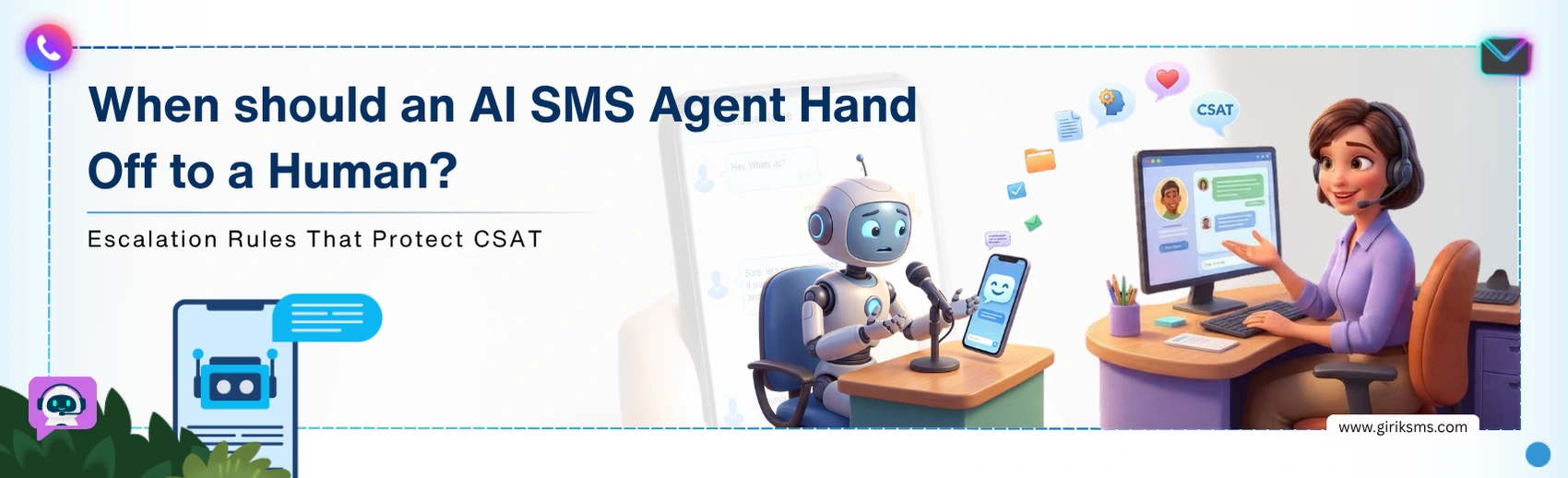
Every AI project eventually reaches the same question. At some point, it is not whether automation can handle a conversation, but how long it must continue before a person steps in. That decision shapes far more than operational efficiency. Too early, an escalation will result in businesses missing out on most of the advantages that automation is intended to bring. Escalation happening too late could lead to customers spending their valuable time in an unresolved discussion.
Finding the right balance does not mean substituting one for the other but rather deciding the extent of automation and when human judgement adds value to that. Well-defined SMS agent escalation rules provide an answer to this dilemma by allowing AI to resolve repetitive tasks and only letting humans intervene when the customer experience begins to suffer.
Why Human Handoffs Matter in AI-Powered SMS Support
There are many examples of customer conversations that fit this purpose perfectly – answering questions, providing updates, booking appointments, or taking the user through a process. The difficulty occurs when the conversation becomes more than just information and demands judgment, negotiation, or empathy.
This is the reason why AI to human handoff messaging is an integral part of the customer experience. Handoff is meant to appear as a natural continuation of the conversation and should not feel as though AI has surrendered. Rather, handoff involves connecting a customer with the appropriate representative without them having to start all over again.
In contrast to phone calls, SMS communication is not necessarily based on immediate responses from both participants. Customers can answer messages within seconds, minutes, or even hours depending on their availability, and hence SMS conversation can take place in two different sessions. Therefore, choosing when to escalate text conversation becomes difficult. Not only are businesses considering whether they should include a human representative in the process, but they are also determining when further automation of the process is less beneficial than handing control of the conversation over to someone.
The Cost of Delayed Escalation
The downside of non-escalated interactions is that the AI conversation may continue even if it doesn't seem useful. The AI agent may continue communicating with the user when the situation requires a human decision, and thus the conversation becomes unnecessarily long and complicated.
Delayed escalation can affect the customer experience in several ways:
- Repeated information: Customers are supposed to repeatedly provide the same information since the AI fails to recognize the need for human escalation.
- Longer resolution times: Each additional automated exchange adds time without necessarily moving the customer closer to an answer or outcome.
- Rising customer frustration: Repetitive or irrelevant responses can make customers feel that the system is not understanding what they are asking.
- Harder human handoffs: The human takeover becomes difficult since they need to work through the entire conversation to understand the context. An ideal live agent handoff SMS should provide the rep with sufficient information to continue the conversation.
SMS Agent Escalation Rules: When to Hand Off and Why It Matters
Not every conversation needs a human. But some do and the difference is not always obvious in the moment. These five escalation triggers give AI SMS agents a clear basis for deciding when to step back and bring a person in.
- 1. Negative Sentiment or Emotional Distress As soon as the customer's tone changes to shorter responses, more forceful words, signs of frustration and impatience, the conversation has passed the boundary of mere information exchange. While AI is able to recognize such signs through sentiment analysis, it is unable to react to them as humans do. Once this happens, further automation of the conversation is pointless and, most likely, counterproductive.
- 2. Repeated Information or Circular Conversations EIf a customer has to explain the same thing again and again without getting anywhere, the AI has already failed to advance the conversation. Redundancy is probably the strongest indicator that something is going wrong here. Keeping on with the conversation is simply useless and even frustrating for the customer.
- 3. Topic Complexity Beyond Defined Scope Some cases involve exceptions, decision-making, negotiating, or judgment, which an AI agent is not designed to do. As soon as the conversation shifts to these kinds of issues, carrying on the conversation using automation poses some risk because the system may either say something it should not or stop replying without providing any explanation. Neither outcome serves the customer well.
- 4. Explicit Request for a Human Agent When a customer directly asks to speak with a person, that request should be honored immediately. Attempting to address the problem by automation beyond a certain point, whether the AI can actually deal with it or not, damages trust and indicates that the business values efficiency over the customer’s choice.
-
5. Time-Sensitive or High-Stakes Situations Financial, medical, legal, or operations-related discussions carry exceptions that cannot be properly handled using automation. In such situations, when the cost of making a mistake is very high, the cost of delayed escalation is also high. These situations require immediate live agent handoff SMS support regardless of where the conversation stands at that point.
Defining SMS agent escalation rules around these five triggers gives businesses a starting point that is practical rather than theoretical — specific enough to configure, flexible enough to adapt as conversation patterns evolve.
Conclusion
The goal of SMS agent escalation rules is not to limit what automation can do. It is to define where human involvement genuinely improves the outcome. Most escalation failures are not technology failures. These are failures on the part of design, in which the criteria that define when control is passed have been either nonexistent, too stringent, or too negligent to fit reality. If escalations take into account customer signals rather than arbitrary cut-offs, then AI does what it is good at and hands off while the situation is still close to recovery.