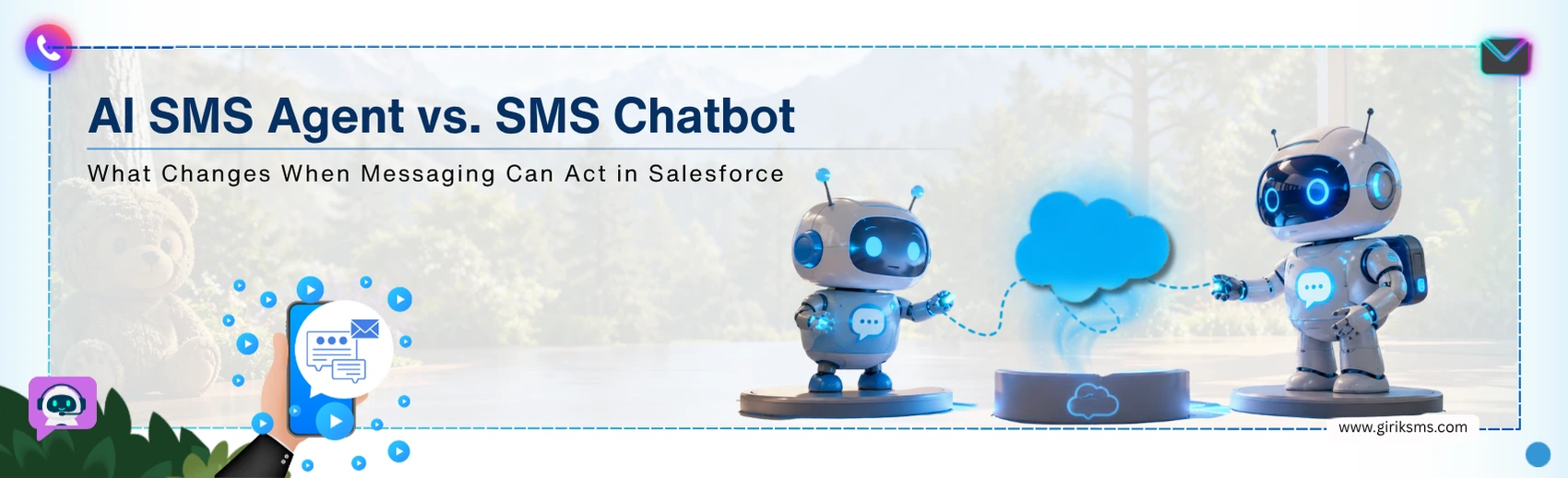
Businesses automate many SMS conversations, but the real difficulty is when a customer needs more than an answer. A request to reschedule an appointment, check an order, update information, access to Salesforce, and an action that goes beyond a predefined response.
This gives rise to an important question: should messaging only provide information, or should it also help complete the process behind customer's request? If automation stops at the response, employees may still have to step in and complete the work manually.
This is where the difference between an AI SMS agent and an SMS chatbot becomes imperative.
While a chatbot can manage predefined conversations, an AI agent can potentially understand the request, use relevant Salesforce context, and take configured actions. The shift is from simply automating the conversation to move the underlying process forward.
AI SMS Agent" vs. SMS Chatbot: What’s the Real Difference?
The easiest way to distinguish between SMS agents and chatbots is to see how they answer a common customer query.
SMS chatbot has set conversation paths that answer common questions, collect users’ data, assist a customer with any procedure, and/or provide the correct response. Preset responses are helpful when there are predictable conversations, and the business wants control over the system response.
An AI SMS agent works differently. It understands more open-ended requests, uses relevant business context, and determines what needs to happen next. Depending on the request and its configuration, it may retrieve information, update a record, or transfer the conversation to an employee.
What Is an AI SMS Agent Inside Salesforce?
Think of AI SMS agent as a messaging layer—connecting a customer's text with the business context and actions stored in a CRM.
For instance, a customer texts:
“I need to change my order’s delivery date.”
An ordinary chatbot will refer customers to a booking page or offer some set ideas only. Whereas AI SMS agent will immediately identify the customer, give order details, process the requested change, start the appropriate workflow, make the changes in Salesforce, and send confirmation.
This is where agentic messaging Salesforce becomes meaningful.
SMS Agent vs. Chatbot: What Really Matters in Salesforce Workflow?
The difference is much more obvious when considering routine business workflows.
01
WORKFLOW
Lead qualification
Chatbot
A chatbot can ask:
“Are you interested in Product A or Product B?”
It can collect the answer and move the customer to the next predefined step.
AI SMS agent
An AI SMS agent can handle a less predictable response, understand the prospect's intent, use available customer context, capture relevant qualification details, and trigger the next configured Salesforce action.
The conversation will be an integral part of the sales workflow and not just a separate messaging activity.
02
WORKFLOW
Appointment changes
Chatbot
A chatbot can guide a customer through a fixed appointment flow, whereas AI SMS agent can understand a natural request. For instance,
“Can you shift my appointment to Friday afternoon?”
AI SMS agent
Once a suitable scheduling action is available, agents immediately use that information, follow a predefined process flow, update records, and then verify the results by sending an SMS.
03
WORKFLOW
Customer service
Chatbot
Chatbots are capable of dealing with basic questions, e.g., operating hours, procedures, or commonly encountered problems.
AI SMS agent
AI text agent maintains the situation of a customer’s concern, and according to its setup, it performs the necessary actions, such as updating the ticket, delivering the information within the ticket, or escalating the situation (only if required).
✓
The important thing here is the connection between a conversation and follow-ups.
From Messaging Automation to Outcome Automation
This is the shift businesses should pay attention to.
Traditional messaging automation focuses on automating the message.
For example:
“Your appointment is scheduled for Friday 10 AM.”
The system sends information quickly and consistently. But outcome automation goes a step further.
A customer replies:
“Can I move it to Monday?”
Now, here comes the role of a system that has to comprehend the customer's needs, know if the request can actually be handled, access the right information, and accordingly take the next action, and finally provide the outcome.
That changes the role of SMS.
Instead of:
Message → Response
the workflow becomes:
Message → Understanding → Decision → Action → Outcome
This is the practical value of agentic messaging. The goal is not simply to make conversations sound more natural, but to connect those conversations with business processes.
This is also where the difference between an AI SMS agent and SMS chatbot becomes crucial. If the system only generates a response but cannot access relevant context or perform configured actions, the business outcome has not really changed.
When Should a Business Choose between a Chatbot or an AI SMS agent, or Maybe Both?
SMS chatbot is appropriate in the following cases:
-
Customer questions are predictable.
-
Conversations follow clear paths.
-
Responses follow predefined rules or pre-approved answers
-
The goal is mainly FAQ or basic information automation.
-
There is little need for CRM-based action.
AI SMS agent becomes more useful when:
-
Customers use natural and open-ended requests.
-
The conversation depends on customer-specific information.
-
Multiple steps are involved.
-
Salesforce actions or workflows need to be triggered.
-
The goal is to complete a business task, not just answer a question.
And sometimes, businesses need both.
While a chatbot deals with simple defined conversations, the AI agent takes care of requests that require more flexibility or actions.
Factors to Consider Before Adopting an AI SMS Agent
-
What Salesforce data can it access? The agent needs relevant context to provide useful responses.
-
What can it actually do? Reading a record and updating one are very different capabilities.
-
Which actions require approval? Not every business process should be fully automated.
Conclusion: The Real Question Is What Happens After the SMS
The transition from SMS chatbot to an AI SMS agent is not actually about giving smart responses, but what the system can actually do as soon as any customer sends the message.
A chatbot can automate predictable communication. AI SMS agent can potentially connect the conversation with Salesforce context, business rules, workflows, and permitted actions.
When SMS is connected to Salesforce, customer messages can do more than just get a reply. It triggers the next step in the business process. That is where messaging starts becoming truly agentic.