



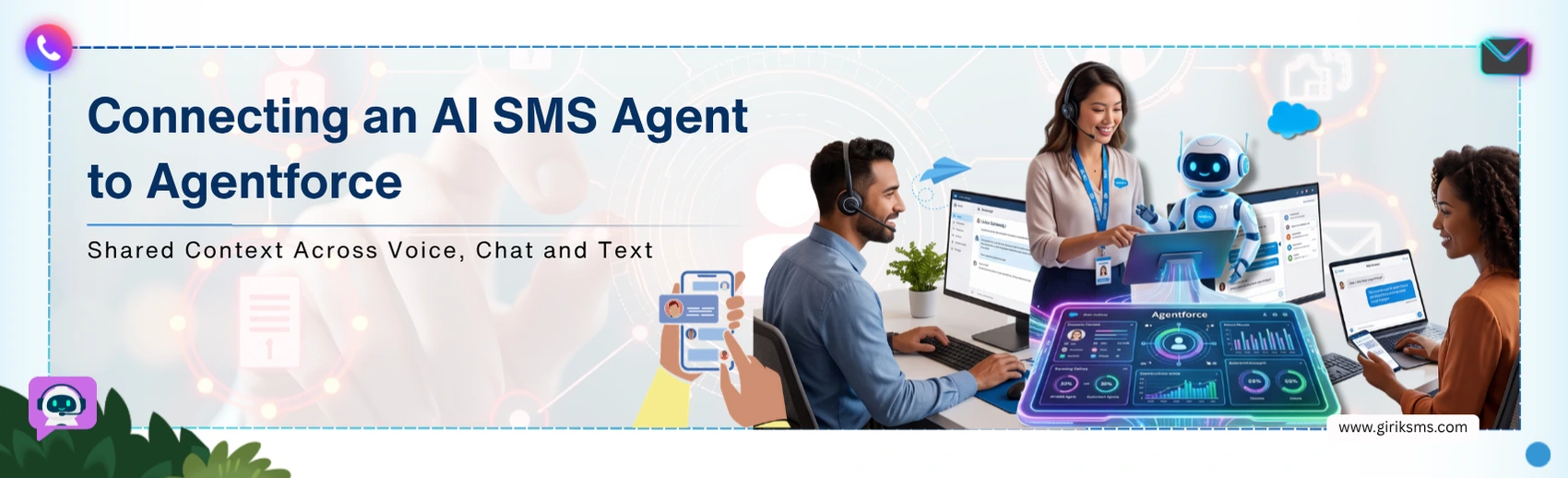
In today’s business environment, interactions happen through multiple channels. A client might connect with a business via phone call in the morning, continue the discussion via what’s App in the afternoon, and respond to an SMS later that day. However, if every channel functions as a distinct AI experience, clients will have to reluctantly repeat information with service teams struggling to recreate the overall customer experience.
So, how to address this issue? Agentforce messaging integration, i.e. integrating Agentforce with an AI SMS agent can be the trick. The objective isn’t just to add SMS as another channel of communication, it’s about creating a connected client experience – enabling various other channels to get access to client data including conversation history, business rules and workflow state.
What Is Agentforce Messaging Integration?
This refers to connecting an Agentforce Service agent to messaging channels so that clients can connect with an AI agent via text-based interfaces. Salesforce supports several messaging channels including but not limited to SMS, WhatsApp, and many more. Additionally, the platform enables messages to be sent to an Agentforce Service agent or directed via Omni-Channel flows.
This difference matters when a company runs an AI SMS agent from a different provider. Rather than replacing the existing SMS technology, organizations must consider creating an integration layer between Salesforce and the SMS agent. Based on the architecture and licensing, this can involve Agentforce APIs, Bring Your Own Channel, Bring Your Own Bot, or other API-based integration patterns.
For instance, Agent API of Salesforce allows external applications to interact with an Agentforce agent via REST APIs. An external client can help create agent session, send texts, get responses and end the session.
What Is Agentforce SMS Integration?
Agentforce SMS integration involves bringing SMS conversations into Agentforce - enabling AI-powered reasoning, access to Salesforce data, and automated processes.
Organizations usually have two approaches.
The first is to use the native Enhanced SMS capabilities of Salesforce, which support AI agent interactions and session transfers. Since Standard SMS channels were retired by Salesforce on February 14, 2026, organizations still making use of legacy architecture require migrating to enhanced channels.
The second choice is to integrate an AI SMS agent with Salesforce. This approach can be a good fit for businesses that use an SMS provider, expert conversational AI, or a tailored messaging infrastructure and are looking connect these capacities with Agentforce.
What is the Significance of Shared Context?
One of the major advantages of amalgamating SMS with Agentforce is context continuity. A customer may query about a delayed order, continue via web chat, respond to an SMS, and ultimately speak with a human agent. In a connected architecture, appropriate details such as client identity, account and order numbers, intent, authentication status, and earlier interactions can follow the clients across channels. This creates unified context in Agentforce, but needs intentional customer identification, data continuity, session association, and context synchronization.
How Can an AI SMS Agent be Connected to Agentforce?
An Agentforce third-party channel architecture can connect clients, an AI SMS agent, an SMS provider, an API layer, Agentforce, Salesforce data and actions. For instance, when a customer texts, “Where is my alternative device?”, the AI SMS agent recognizes the customer and interaction, while the integration layer sends the message, client ID, and interaction ID to Agentforce. Agentforce takes back appropriate Salesforce data, confirms the replacement order status, employs business rules, and produces a response that is accepted. The response then goes back via the integration layer to the SMS platform, allowing the customer to receive precise delivery information that too in real-time.
Connecting Voice, Chat and SMS
The true value becomes obvious when the same structural design extends beyond SMS. Agentforce Voice can handle voice interactions and work with Salesforce Voice or third-party telephony providers. Salesforce asserts that its voice architecture can safeguard call transcripts and session context during voice interactions, including transfers between virtual and human agents in established Salesforce Voice scenarios.
Meanwhile, Agentforce messaging supports optimized channels and context variables.
This creates the possibility of broader architecture:
- Voice → Agentforce
- SMS → Agentforce
- Web Chat → Agentforce
- WhatsApp → Agentforce
- WhatsApp → Agentforce
- Human Service Rep → Salesforce Service Console
The answer is to ensure every channel shares the same client and business context rather than operating as disparate silos.
What are the Benefits of a Connected Agentforce SMS Strategy?
A well-integrated Agentforce SMS architecture can create a hassle-free and efficient service experience across channels.
- Better customer experience: Customers can switch between chat, voice and SMS without having to provide the same details repeatedly.
- Greater AI accuracy: Agentforce can rely on CRM data, client history, and business data to offer smart responses.
- More efficient service teams: When interaction is escalated, service reps have access to broader interaction about history and customer context.
- Faster issue resolution: AI agents can recover data and initiate approved workflows – decreasing the need for human intervention in mundane requests.
- Greater flexibility: Businesses can persist using their current third-party SMS infrastructure while connecting it to Salesforce and Agentforce.
What is the Future of Agentforce SMS Integration?
The future of Agentforce SMS integration lies in creating connected AI experiences that uphold customer context across voice, chat, and text. An Agentforce third-party channel can extend the AI capabilities of Salesforce while connecting customer history, identity, business rules, APIs, and workflows. Rather than operating as a single messaging tool, SMS can become part of a unified interaction architecture - enabling quicker resolutions, steady interactions, and seamless channel switching.