



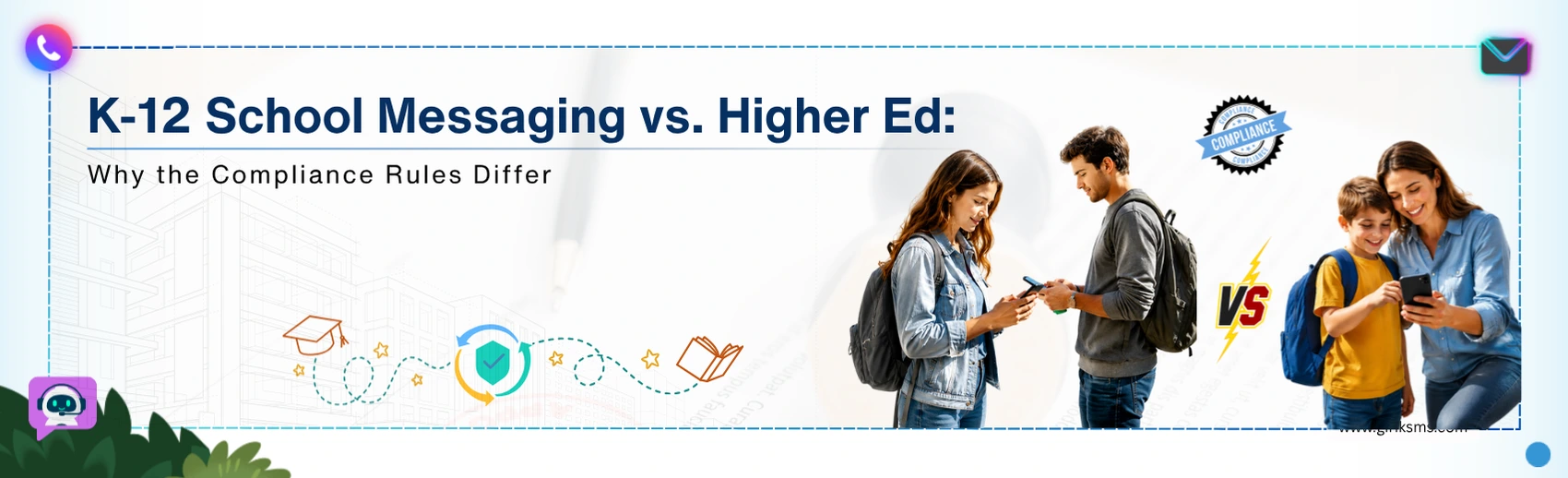
The conversation about student communication has gotten genuinely complicated over the last several years, and not in a way that most institutions were prepared for. Salesforce Education Cloud compliance sits at the center of that complication - not because the platform creates the regulatory burden, but because it inherits every layer of it, and the layers look completely different depending on whether you're messaging a seventh grader or a college sophomore. Worth noting that this distinction gets collapsed far too often in vendor conversations, usually because the sales cycle is easier when everyone's treated as roughly equivalent. They're not.
How Age Changes Everything About Consent
The foundational problem with student messaging isn't channel selection or delivery speed. It's who legally controls the relationship.
In K-12, that question has a relatively clear answer for most students under 18 - the parent or guardian holds consent rights, and federal frameworks like FERPA and COPPA (at least for students under 13) reinforce that position in ways that shape every downstream decision. A school district sending an SMS to a student's personal mobile number without parental consent isn't just a policy gap. It's a compliance exposure that can carry real consequences. Which is why most district-level communication defaults to reaching parents rather than students directly, even when students are, say, sixteen and perfectly capable of reading their own messages.
Higher education operates under a different assumption. Once a student turns eighteen - or in some cases, as soon as they enroll regardless of age - FERPA shifts control of the student record to the student themselves. Parents lose automatic access. That single shift changes the consent architecture for messaging entirely, and honestly it changes the risk profile of the CRM configuration underneath it too.
Why the Platform Configuration Has to Reflect the Institution Type
Here's the thing about building messaging infrastructure on Salesforce: the platform doesn't automatically know it's talking to a minor. That awareness has to be built into the data model, the consent fields, the automation triggers, and the opt-in workflows - deliberately, by people who understand what's at stake.
Salesforce K-12 Architecture vs Higher Ed diverges in a few structural places that matter more than most implementation teams initially expect. The Education Data Architecture (EDA), which Salesforce developed to give both sectors a shared data foundation, still requires institutions to layer their own compliance logic on top of it. EDA gives you relationship objects - household accounts, contact roles, affiliation records - but it doesn't come pre-loaded with COPPA guardrails or institutional messaging policies. That's configuration work, and it belongs to the institution.
In K-12, this usually means:
- Consent is tracked at the guardian level, not the student level, for all outbound messaging
- Automated campaigns need to exclude student mobile numbers unless explicit parental opt-in is documented
- Data sharing between systems - especially third-party SMS providers - carries additional scrutiny under FERPA's school official exception rules
- Age segmentation in the CRM has to be maintained with enough accuracy to actually catch edge cases, which it often isn't
In higher ed, the same framework shifts toward student-centered consent management, but with TCPA sitting heavily on top of everything. The Telephone Consumer Protection Act doesn't care whether you're a university or a cell phone carrier - autodialed or prerecorded messages to a cell phone without prior express written consent are a liability. The "nonprofit exemption" some institutions assume they have is narrower than most institutional counsel would like.
The SMS Channel Is Where the Regulatory Layers Actually Stack
Education Cloud student messaging laws aren't uniform, and they don't layer predictably. What you end up with is federal statute (FERPA, COPPA, TCPA) sitting alongside state-level student privacy laws that vary substantially - California's SOPIPA, for instance, imposes restrictions on ed-tech vendors that go beyond what federal law requires, and several other states have passed similar legislation in the last few years.
That means an institution deploying Salesforce for SMS communications is operating under something like this:
| Regulatory Layer | K-12 Impact | Higher Ed Impact |
|---|---|---|
| FERPA | Consent held by parent/guardian (most cases) | Consent held by student at enrollment |
| COPPA | Applies to students under 13 | Largely not applicable |
| TCPA | Applies to any autodialed SMS to mobile | Applies fully - no institutional exemption |
| State privacy laws | Often stricter than federal baseline | Varies; some states apply to 18+ students |
| Institutional policy | District-level variation is significant | Often more standardized internally |
The TCPA row in the table above deserves more attention than it usually gets in implementation planning, because it applies equally in both sectors and the penalties for violations are per-message. A single poorly configured automation that fires to a list without documented consent can generate exposure that makes the cost of the CRM implementation look trivial by comparison.
What Salesforce Actually Provides - and Where It Stops
Salesforce Education Cloud gives institutions a reasonably strong foundation for contact management, journey automation, and communication personalization. Honestly, for both sectors, the capability ceiling is high. The problem isn't capability - it's that Salesforce Education Cloud SMS regulations compliance isn't something the platform enforces on your behalf. It surfaces in configuration choices, data hygiene practices, consent field design, and the governance decisions institutions make about which contacts are eligible to receive which message types.
The practical gap tends to show up in a few recurring places. Consent records get created inconsistently because the intake process varies by enrollment channel. Opt-out handling between Salesforce and the SMS delivery provider (whether that's a native tool or a third-party integration) isn't always synchronized in real time. And audit trails for consent - which TCPA litigation tends to request very specifically - aren't always structured in a way that's easy to produce under pressure.
To be fair, these are solvable problems. But they require someone in the implementation to own them explicitly, which is where a lot of projects drift.
Implementation tip: Before configuring any automated SMS journey in Education Cloud, map every contact type in your data model to a consent status field that is tied to a documented opt-in record. This sounds basic. Most projects skip it or defer it until after go-live, and the cleanup cost is not small.
K12 School Messaging Salesforce: The Governance Question No One Wants to Own
One of the more uncomfortable patterns in K-12 deployments specifically is that the governance question - who decides which students or guardians can be messaged, through which channels, under what conditions - tends to fall between IT, communications, and legal in a way that means none of them fully own it. IT owns the platform. Communications owns the message. Legal gets consulted occasionally. The consent management infrastructure ends up as a kind of shared orphan that everyone assumes someone else has handled.
Higher ed has a version of this problem too, but the organizational structures around student communications are often more developed - there's usually a dedicated enrollment management or student affairs function that has at least some familiarity with FERPA obligations. K-12 districts, particularly smaller ones, are often building this governance from scratch at the same time they're building the platform, which is a genuinely hard situation to be in.
The Timing Problem Is Probably More Important Than the Tool Choice
Getting the platform right matters, but the compliance gap in student messaging - across both sectors - usually opens up not because of bad tooling but because of timing. Consent processes get designed for the enrollment moment and then never revisited. A student turns eighteen mid-year and the consent architecture doesn't update. A parent opts out of SMS, and the record updates in Salesforce but not in the delivery provider's suppression list. The message goes out anyway.
These are process failures layered over configuration gaps layered over governance ambiguity. The platform doesn't prevent them automatically, and in some ways the ease of setting up automated journeys in Education Cloud makes the problem slightly worse - it's easy to build a sophisticated-looking communication workflow that has a significant compliance hole sitting quietly inside it.
That tension - between how good the tooling has gotten and how slowly institutional governance has caught up - is probably where the real K-12 and higher ed story actually lives. The rules differ, yes. But the execution gap looks remarkably similar in both sectors, and it doesn't close just because the platform is capable of handling it correctly.