



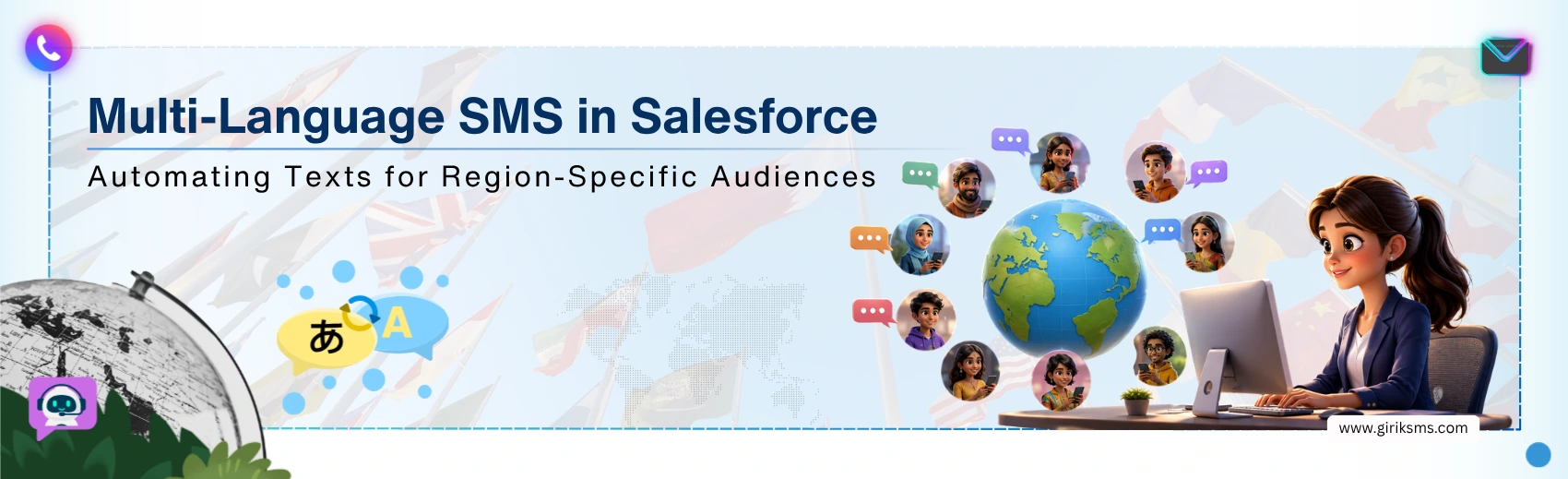
An SMS message requires just a few seconds to be read. However, when customers receive an SMS in a language unfamiliar to them, it is usually ignored at once. Clients prefer messages w.r.t transactions, appointments, goods delivery, or promotional offers in their preferred language.
As businesses expand into new regions, they must have SMS communication that adapts to every customer's preferred language and geography.
This is precisely where Salesforce teams experience difficulties. However, even with all the information provided such as language preferences, or geographical location, companies will have to design various SMS campaigns, handle various templates, or use external solutions to contact their clients in various languages.
Fortunately, Salesforce has the necessary data for automating this process. By combining CRM data and intelligent messaging, businesses can send their customers the necessary SMS in their chosen language without operating separate campaigns.
If you're looking for message language automation Salesforce, this guide will help you learn about multilingual SMS automation, the process of creating region-based messaging journeys, and how to communicate effectively with customers.
Why One Language SMS No Longer Meets Customer Expectations
Sending same text messages for all customers allows the company to conduct mass marketing campaigns. But it does not necessarily deliver the expected result. In this case, the role of language appears in personalization, especially in the case of global companies.
Here are some negative implications of single language messaging:
- Low engagement: Customers will be more receptive and responsive to the message in their preferred language.
- Miscommunication: Customers may lose essential information such as appointment reminders, payment reminders, or delivery updates as these may not be delivered to the customers in the language they prefer.
- Customer Experience Inconsistency: No amount of personalization will matter if the message is not communicated effectively.
- Higher Operational Effort: As the user base expands, running separate manual campaigns per language gets complicated quickly.
- Limited Scalability: Businesses can’t just expand to other geographies by simply augmenting their current automated process with new campaigns.
Such challenges make businesses use automated language-sensitive messages in Salesforce rather than relying on manual campaigns.
How Salesforce Automates Multi-Language SMS
Most businesses already collect the information they need for personalized SMS communication. Customer records often include preferred language, country, state, or other details that may help to decide which message should be sent. Thus, instead of forcing teams to divide contacts manually before each campaign, Salesforce can use this CRM information to automate language selection in the messaging process.
This makes Salesforce locale SMS strategies much easier to implement. Rather than operating a set of campaigns for every language such as English, French, Spanish, etc., firms can just utilize a single process that chooses the right template, based on the customers' information.
When new markets emerge, teams must adapt by adding more language templates into the existing automated process instead of recreating campaigns from scratch. As a result, the messaging process remains the same and saves time for marketers.
Beyond Language: Why Region-Specific Messaging Matters
SMS sent in the customer's native language is one thing, but this does not automatically mean that there will be localization. People in various parts of the world could use the same language, but they expect different things to be used, such as date format, currency, time zone, seasonal promotions, and even language itself.
That is why localization is equally essential as translation. Rather than translating text to another language, companies should customize SMS campaigns to meet regional tastes and customer expectations. By combining language preference and CRM information based on location, region specific SMS automation can help Salesforce craft relevant messages for every segment of the audience.
Best Practices for Building Multi-Language SMS Workflows in Salesforce
While setting up multilingual SMS campaigns is simple, managing them may become complex as they scale.
Having an organized workflow lets companies make sure their message gets across to the right people — without having to set up campaigns for each language individually. Teams can save time through standardization without compromising the customer's experience.
Here are some ways to develop multi-language SMS workflows in Salesforce:
- Keep language preferences updated: Store your customer’s language preference in Salesforce and keep it updated when you get new information about it.
- Create approved SMS templates: Have a separate SMS template for every language that is offered by your company.
- Automate instead of manual segmentation: Use workflows in Salesforce to choose the right SMS template according to the language of the customer or his region.
- Pre-launch test messages: Test all the translations, Unicode, links, and formatting of the message to make sure there will be no problems in delivery.
- Monitor engagement by languages: Get statistics about how many times messages were delivered, clicked, and answered.
With an increase in multilingual messaging, many companies are also integrating AI messaging on Salesforce in order to make it even more automated. With the help of AI, it will be possible for organizations to personalize their messages, provide them with templates that are relevant to them, and trigger messages depending on customers' actions.
Choosing the Right Salesforce SMS Solution for Multi-Language Messaging
The ideal solution for multilingual SMS must have both automation and application that support multilingual templates, CRM-based workflow, and regional messaging. While choosing the best Salesforce SMS apps, one must take into account: Salesforce integration, multilingual template support, automation, reporting, and scalability.
All of these are provided by GirikSMS, which lets companies automate multilingual SMS, customize SMS with Salesforce CRM, and coordinate regional SMS through one unified platform. It makes it easy for teams to provide consistent experience to customers without having to spend too much effort while expanding into new regions.
Concluding Words
With businesses reaching out to clients in different locations, sending SMS in the right language has been an integral component of the process of delivering great customer experience.
What is more important than translation is that Salesforce automation ensures the relevance of every message sent by making use of information about the client in Salesforce.
Through the proper implementation of multilingual messaging and the proper choice of Salesforce SMS services, businesses can save time and effort, engage customers better, and send personalized messages easily and without any problems.