


Customers like to connect with companies on their terms. Some check emails on a daily basis; others might prefer texts, or even WhatsApp.
At the end of the day, customers don't really care about any communication channel; all they want is to have a conversation without repeating their query multiple times on different communication platforms.
That's where many businesses struggle. Their marketing emails might be planned in one system; SMS campaigns are running on a completely different system. A siloed approach leads to a disconnected customer experience because the messages get duplicated, the context is lost, and customers feel like they are starting from scratch each time.
According to Salesforce’s report, 73% of customers expect companies to know their requirements and expectations and make communications connected rather than disconnected.
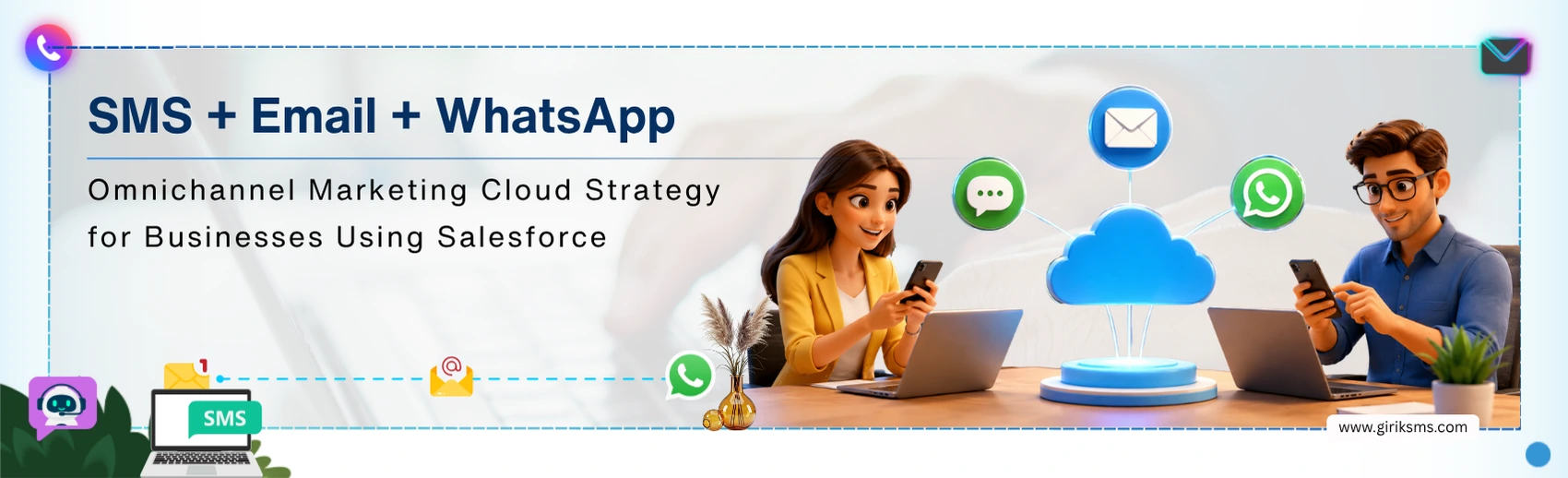
Companies can utilize the right omnichannel messaging, WhatsApp, email, and SMS strategy to meet the customer’s expectations. In this guide, we'll learn how businesses in Salesforce can integrate these three major means of communication to create a customer experience that is more significant and engaging.
Why Email, SMS, and WhatsApp Work Better Together
There is no single communication channel that can handle every customer interaction.
Each communication platform serves different purpose, for example:
- Email is the ideal communication platform for sharing detailed information.
- SMS is effective at capturing someone’s attention instantly; but it isn’t the right channel for ongoing communication.
- WhatsApp is perfect for fast and easy two-way communication, but it cannot be applied in all campaigns.
The actual value lies in using the most suited communication platform during the right stage of the customer journey.
Imagine a typical journey of any customer:
Email: Receive a product brochure
⬇️
SMS: Get a webinar invitation and reminder
⬇️
WhatsApp: Ask product-related questions
This is what makes omnichannel communication platforms more effective.
The approach works beyond marketing campaigns and extends to other touchpoints such as appointments, order confirmation, billing notifications, customer service, or even post-sale engagements.
Companies should take advantage of the communication channel which aligns well with their audience’s intention instead of sticking to only one channel for all purposes. In doing this, they will create a unique “communication journey” where Email, SMS and WhatsApp are used differently yet to fulfill the exact purpose.
The real advantage lies in ways each channel complements each other. With these communication platforms sharing information about customers rather than working on their own, companies can provide relevant experiences, minimize communication barriers, and ensure consistency in their branding efforts from beginning to end.
That is what an omnichannel messaging platform for chat, SMS, and WhatsApp necessitates—and why more Salesforce firms are adopting a unified messaging strategy.
Understanding the Role of Email, SMS, and WhatsApp in an Omnichannel Strategy
A successful omnichannel strategy just needs a defined purpose behind every channel and to consider where it actually has a great impact. Every planned interaction with the customer's ongoing journey feels more relevant and connected, and not just a repetition of the same conversation.
Email: Building Context and Nurturing Relationships
Email is most effective when there is more than just an update to give to the client. The email can be used for product launch, training, or lead nurturing. It enables one to share in-depth and personalized content since it gives you room to share your whole story without having to alarm the customer with constant notifications.
SMS: Delivering Information That Can't Wait
Some messages need instant attention - payment confirmation, appointment notifications, OTP, package information or limited time offers - these are a few of them which would draw more customer attention if sent over SMS than email. It is not about replacing emails but making sure that the customer gets the information on time.
WhatsApp: Turning Notifications into Conversations
WhatsApp gives companies an option that is not available on other one-way channels; it enables companies to keep the conversation going. It is possible for customers to ask their queries, seek any information regarding the products, make an appointment confirmation, or seek assistance all on this same platform.
The key benefit arises from the collaboration between these channels rather than working in isolation.
A customer will get an initial notification regarding the announcement of a product through email, then be prompted with an SMS message before the expiry of a promotional offer, and have a further clarification call out via WhatsApp before purchasing.
Each communication is transferred seamlessly from one channel to another – ensuring consistent messaging across chat, SMS, and WhatsApp while avoiding the need to repeat themselves.
How Salesforce Marketing Cloud Connects Email, SMS, and WhatsApp
Incorporating Email, SMS, and WhatsApp in your marketing strategy is one thing. But, how to make them work together as one customer journey is another. When businesses do not use a single platform, customer messages tend to become lost in different applications which diminishes the chances of providing personalized and seamless customer experience.
This is where the Salesforce Marketing Cloud comes into play. Rather than running all channels as separate campaigns, it lets companies run their communication based on customers' behaviors and interactions with the company in one common environment.
Suppose a customer checks their email but does not go through with a purchase; they receive an SMS reminder after a predefined time. In case they do not take any action but then visit your website or place an inquiry, the journey can continue via WhatsApp with an answer at their disposal. Such exchanges are organized in a way that each of them builds on the previous interaction.
This kind of coordination is made possible by the fact that Marketing Cloud integrates data from the customer in the Salesforce environment. Without having to make any assumptions about the people you are dealing with, companies can segment their customers based on the data from the CRM system, purchase behavior, and customer preferences.
Automation also plays a significant part in this regard. Rather than manually determining when to send the next message, organizations can craft customer journeys that react to immediate actions. This could be a welcome journey, cart abandonment reminder, appointment confirmation, or even a post-purchase journey - the choice is endless as every journey is triggered by the customer's behavior and not by time.
As a result, the enterprise offers a cohesive experience to the customers instead of running various campaigns — ensuring that the customer receives appropriate messaging through the most suitable channel at a specific time.
Building High-Impact Customer Journeys with Email, SMS, and WhatsApp
Following are some examples that will help Salesforce businesses integrate email, SMS, and WhatsApp without any hassle.
| Customer Journey | Example Omnichannel Workflow |
|---|---|
| Lead Nurturing | The prospect receives the eBook download and receives a welcome email. If he or she does not schedule a demo at that point, an SMS reminder follows a few days. As soon as the prospect shows interest, the sales process continues through WhatsApp. |
| Abandoned Cart Recovery | The customer adds products to his/her shopping cart but doesn’t complete the purchasing process. The customer is reminded of the items via email, and then an SMS is sent highlighting that there is a limited time offer on the products. In case of no response, WhatsApp can be used. |
| Appointments & Service Reminders | Email is used for confirming an appointment, while an SMS alert is helpful for reducing missed appointments at a later stage. Then customers can communicate through WhatsApp without making any calls to the customer care center. |
| Order & Delivery Updates | The clients will be informed about their orders via emails, get their shipping alerts through SMS, and get live delivery updates or assistance via WhatsApp. |
| Post-Purchase Engagement | Once the clients have purchased something, businesses can give them onboarding material via email, collect client feedback on WhatsApp, and inform their clients about loyalty programs via SMS. |
Best Practices for Building an Effective Omnichannel Strategy
Even with the proper technology, the omnichannel approach can still fail if there is no proper planning involved. Here are some best practices which can assist Salesforce companies in forming a better customer experience through an omnichannel approach.
Define the Purpose of Every Communication Channel
Just because one has the ability to send a message using Email, SMS, and WhatsApp does not mean that he/she should use all three to send the same message. There should be a specific purpose for using each mode of communication.
Personalize Communication Using Salesforce Data
Leverage the CRM data, such as customer preference, buying behavior, interaction record, and other such things to make each message relevant. Personalized marketing becomes more effective when all channels use the same customer information base.
Automate Journeys Based on Customer Behavior
Don’t schedule emails on specific timeframes; rather, craft journeys based on customers’ behavior. Whatever a person does, from opening an email through abandoning a shopping cart to asking for a demo, the following step should be taken accordingly.
Respect Customer Communication Preferences
Not everyone prefers to receive every update via the same contact method. Giving customers the choice of how businesses can communicate ensures greater engagement and prevents message fatigue.
Measure Performance Across the Entire Journey
Do not analyze each campaign of Email, SMS, and WhatsApp individually. Analyze the performance collectively based on customer engagement, conversions, response rate, and journey completion.
The Bottom Line
Consumers will keep shifting between Email, SMS, and WhatsApp without even giving it a second thought, and consumers expect businesses to do the same. What really sets out a business apart is not the number of communication channels that they use, but the ease with which they integrate these channels to provide a seamless and personalized experience to the consumers at all contact points.
When it comes to businesses leveraging Salesforce, the integration of email, SMS, and WhatsApp within a single customer experience is not about enhancing the level of engagement, but about creating more meaningful interactions which will help in building stronger relationships. It all depends on how well you leverage the right data, automation, and context for your customer experience.