



Most teams don't think about the underlying message classification until something breaks. A carrier flags their number. A campaign gets blocked. A brand that has been running outbound texts for two years suddenly finds its delivery rates cratering and nobody on the team can explain why. That's usually when the question finally surfaces: are we sending peer to peer texting, or is this A2P traffic? And does it actually matter which one we call it? A2P 10DLC Salesforce compliance is exactly the kind of question that gets ignored until it's urgent.
It matters quite a bit, as it turns out. And the distinction is not just semantic.
What These Two Categories Are Actually Describing
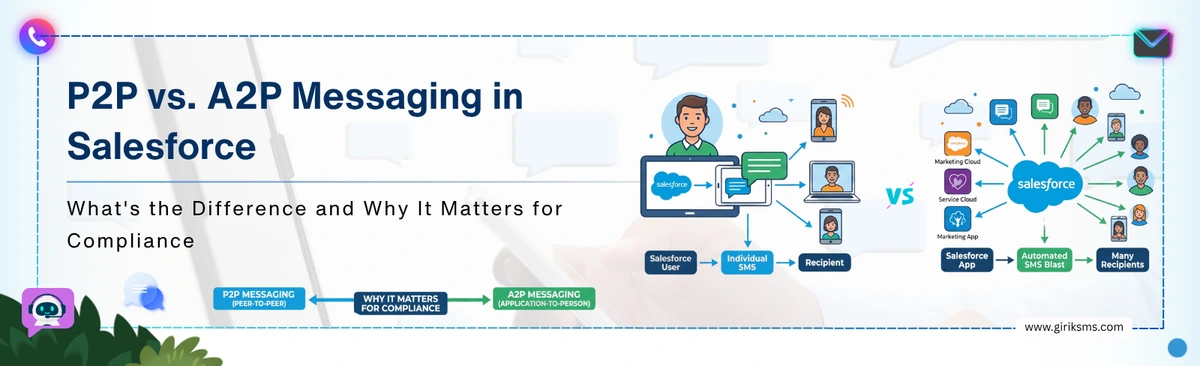
Peer-to-peer messaging, in its most literal sense, describes a message sent from one person to another person - real human to real human, on a personal device, usually in a conversational rhythm. Think of someone on your sales team texting a prospect from their own number, back and forth, in something that resembles a normal conversation. That's the classic version of P2P.
A2P - application-to-person - describes messages generated and sent by software on behalf of a sender, usually at some volume, usually triggered by a workflow or system event. When a customer gets an automated order confirmation, or a reminder about an upcoming appointment, or a promotional offer sent to a list of ten thousand contacts, that's A2P. The application is doing the sending. The person is just receiving.
Neither category is inherently better. But they operate under completely different rules. And the compliance implications of misclassifying one as the other have become significantly more consequential over the last few years.
Where Salesforce Sits in This Picture
Salesforce is not, by itself, a messaging carrier. Worth saying plainly, because there's a tendency to conflate the CRM layer with the delivery infrastructure. Salesforce provides the workflow logic, the contact data, the automation triggers - the actual text delivery runs through third-party SMS providers that are integrated into the platform via APIs or native connectors.
That matters because the compliance obligations - registration requirements, opt-in handling, content policies - are enforced at the carrier level, not the CRM level. Salesforce can help you build a beautifully organized messaging operation, but if the underlying message type hasn't been classified and registered correctly, the carriers will still block or filter it.
Most Salesforce messaging use cases, if we're being honest, land firmly in the A2P category. Automated nurture sequences, appointment reminders, case update notifications, marketing campaign sends - all of it is software-initiated traffic at some kind of scale. The P2P framing sometimes gets applied, loosely and incorrectly, to justify skipping the registration steps.
That's where a lot of organizations get into trouble.
The A2P 10DLC Requirement and Why It Caught Teams Off Guard
Back in 2021, U.S. carriers started actually enforcing campaign registration requirements for A2P traffic moving over ten-digit long codes - those standard local-looking numbers that businesses had been quietly using for years, mostly without incident.
The system - A2P 10DLC Salesforce, which practitioners really started wrestling with around 2022 - requires senders to register their brand and their specific messaging campaigns with a central registry. Both things. Not one or the other.
The intent, nominally, was to cut down on spam and give consumers some protection. Whether it fully achieved that is a separate conversation.
The practical result, for teams that hadn't registered, was delivery degradation and in some cases outright blocking. Carriers were given the authority to filter unregistered A2P traffic, and they used it.
A lot of Salesforce shops were caught mid-campaign. Honestly, the failure mode here was predictable - organizations had been running long-code SMS for years without much friction, so the incentive to reclassify or register was low until the carriers started enforcing. Volume-based filtering created the pressure that compliance awareness hadn't.
The distinction between P2P and A2P became, practically overnight, a registration and financial question rather than just a definitional one.
How to Think About P2P vs A2P Messaging Inside Your Salesforce Org
The actual classification work isn't always clean. There are gray areas, particularly in inside sales environments where reps are texting prospects manually but from a shared number that's managed by a platform. Here's a rough framework for thinking through where your traffic falls:
- Who initiates the message - A human composing a text in the moment is pointing toward P2P. An automated workflow, a Journey Builder send, or a trigger-based flow points clearly toward A2P. The composition method matters more than the content.
- What the volume looks like - A single rep texting twenty people a day manually looks different from a system dispatching a thousand messages in an hour. Carriers evaluate both patterns and volume when flagging traffic, and high volume is almost always treated as A2P regardless of how the sender describes it.
- Whether the message is personalized or templated - this factor is less clear-cut than the others, but sending templated content to a list is a solid signal of A2P, and it's often classified accordingly.
- How the opt-in was collected - A2P compliance requires documented, explicit consent that meets carrier standards. If your opt-in process was designed for transactional notifications and you're now sending marketing content, that gap is a compliance exposure regardless of message type.
A Practical Comparison
| Factor | P2P Messaging | A2P Messaging |
|---|---|---|
| Initiated by | A human, in real time | Software or automated workflow |
| Typical volume | Low, conversational | Medium to high, list or trigger-based |
| Registration required | Generally not required | Required under 10DLC rules in the U.S. |
| Opt-in standards | Informal but still advisable | Formal, documented consent required |
| Content type | Conversational, unscripted | Templated, scheduled, or promotional |
| Carrier scrutiny | Lower | Higher, especially at volume |
The shaded line in this table is volume. Carriers use volume as a proxy for A2P behavior even when the sender insists the traffic is person-to-person. A team of five reps sending a hundred texts each per day from a shared Salesforce number will likely trigger A2P filtering regardless of whether anyone in the organization thinks of it as "automated."
What Compliance Actually Requires in Practice
The compliance layer here is layered over technical requirements, layered over carrier policy, layered over organizational process - and the fact that those three things rarely update on the same schedule is its own ongoing problem.
For A2P traffic running through Salesforce integrations, the baseline expectation in the U.S. right now involves brand registration through The Campaign Registry, campaign use case registration with carrier-specific vetting, opt-in language that actually names the message type being sent - not just vague consent boilerplate - and opt-out mechanisms that work when someone uses them.
Carriers have not been consistent about when they enforce versus when they announce, which is its own problem. Compliance teams end up reactive almost by design.
Worth noting - and this gets overlooked more than it should - even for use cases that genuinely qualify as peer to peer texting, not having opt-in records is increasingly a liability. State-level privacy law is filling gaps the federal framework hasn't touched, and "it was person-to-person outreach" doesn't hold up especially well when a complaint actually lands.
The Classification Question Isn't Going Away
Here's where this ends up, at least for now. The P2P versus A2P distinction started as a technical classification built around how messages were generated and delivered. It has evolved into a compliance and registration framework with real financial and operational consequences. Teams building messaging strategies inside Salesforce need to understand which category their traffic actually falls into - not which category is most convenient to claim.
As messaging volumes climb and consumer complaints about unwanted texts pile up, the appetite for enforcement - regulatory or otherwise - is probably going to follow. Where the next push comes from is honestly hard to predict. FCC rulemaking, state privacy legislation, carrier-driven policy shifts - any of those could move first, and the sequencing isn't obvious. But the direction of travel is toward more classification specificity, not less. Organizations that have invested in getting their messaging taxonomy right will have significantly less ground to cover when the next requirement lands.