




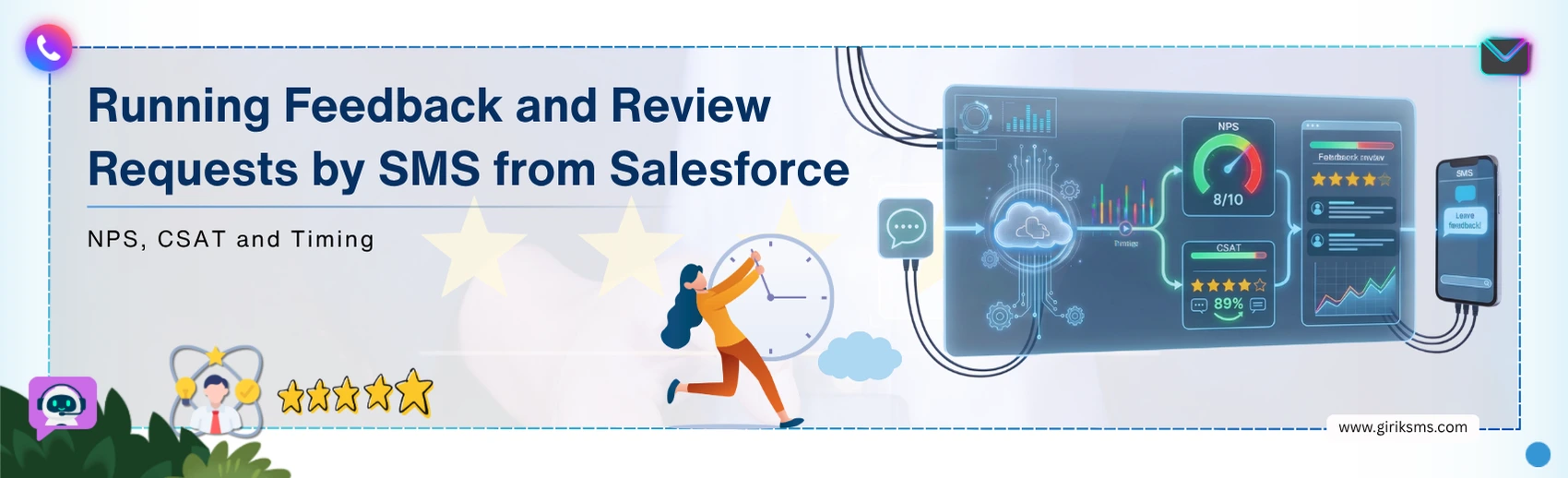
A business can see its sales numbers, track renewals, and watch how many new customers arrive through referrals. What is harder to see is how existing customers actually feel about the experience they are receiving. A customer may stay quiet, renew without complaint, or simply move on when something goes wrong.
That makes customer feedback more than a measurement exercise. It gives teams a way to find out what customers think while there is still time to act on it. Salesforce SMS survey feedback gives teams a way to collect those responses through messaging channels customers already use and connect the feedback to the existing customer record. With this, the focus naturally shifts to how businesses can use NPS scores and CSAT to understand customer sentiment, and how timing can influence the feedback they receive.
Why Use SMS for Customer Feedback in Salesforce?
SMS can make feedback collection faster than email. Text messages typically carry higher open rates and take less time to respond to, making them useful when businesses want feedback while the customer experience is still fresh.
The bigger advantage is in connecting the message to the Salesforce workflow. A team can trigger a CSAT request after a case is closed, send a feedback question after onboarding, or request a response after a completed purchase. The response is then linked to the corresponding record in Salesforce rather than stored separately in a survey system.
SMS makes two-way communication possible within the customer workflow. The customer can reply to the message, and the response is used by Salesforce to trigger the next activity. The same approach applies to a review request SMS. Businesses can send out the request after a defined customer interaction and use the Salesforce data to determine who to send it to, when to send it, and the follow-up actions.
NPS via SMS to Measure Customer Loyalty
Net Promoter Score (NPS) is an indicator of the likelihood of a customer recommending your business, product, or service. NPS measures customer loyalty and encompasses the entire customer experience, not a specific one. Customer satisfaction is rated from 0 to 10 depending on their willingness to recommend the business. The results are then put in three categories:
- Promoters (9–10): Customers who are highly likely to recommend the business.
- Passives (7–8): Customers who are satisfied but less likely to actively recommend it.
- Detractors (0–6): Customers who are less satisfied and may indicate a risk to retention.
The percentage difference between promoters and detractors gives NPS. Passives are included in the responses but do not directly affect the score.
An NPS text survey can be triggered from a customer milestone such as onboarding or renewal. Once the customer has responded, the score can then be assigned to the respective Salesforce Contact/Account, giving the team context on the response. This is further used to initiate a particular action, such as sending a follow-up message to the accounts with lower NPS.
CSAT to Capture Feedback Immediately After an Interaction
Customer Satisfaction Score (CSAT) indicates how satisfied the customer was with the experience that occurred during some particular interaction. In contrast to NPS, which examines the overall customer relationship, CSAT examines only one of the elements of the customer journey.
A usual CSAT survey includes a request to evaluate the customer's satisfaction on a scale, say, from 1 to 5. Businesses then calculate the percentage of responses that fall within their defined satisfied range. The scale and calculation can vary depending on how the organization designs its survey. CSAT can be used after specific customer interactions, including:
- Case resolution: Was the support experience satisfactory?
- Onboarding: Was the onboarding process effective?
- Purchase/delivery: Was the purchase or delivery process satisfactory?
- Service interaction: Did the team resolve the customer's issue as expected?
With CSAT texting CRM workflows, a Salesforce event can trigger the survey at the right point in the interaction. For instance, once a Case has been closed, Salesforce can trigger an SMS CSAT survey. The customer's response is linked to the Case or Contact, while a low score can prompt a follow-up action for the case owner's review.
This gives service teams Salesforce SMS survey feedback that is tied to the interaction being measured. Instead of treating the CSAT response as a separate survey result, teams can use it alongside the Case or Contact record to identify service issues and decide where follow-up is needed.
Getting the Timing Right for SMS Feedback
Timing of the feedback request is crucial for determining how genuine the response is. Send too early, and the customer has not formed a view yet. Send too late and the moment has passed.
CSAT and NPS follow different timing logic:
CSAT should go out as close to the interaction as possible, ideally within the same hour a case is closed, an onboarding session ends, or a delivery is confirmed. The experience is specific and recent. Even a 24-hour delay begins to impact response accuracy.
NPS is more effective when linked to some kind of relational event or milestone: renewal, completion of an onboarding process, or some months into the agreement. Sending the survey too soon after a single contact may capture only the emotions of the moment and not the true loyalty sentiment. It should also be spaced out. Sending NPS too frequently trains customers to ignore it.
Salesforce SMS survey feedback workflows make timing enforceable rather than aspirational. The trigger is built into the record: a case status change can trigger a CSAT survey, while a contract anniversary can trigger an NPS survey.
Conclusion
Customer feedback has always been valuable. A business’s ability to create strong bonds through its feedback process hinges on its timeliness, execution, and decision-making regarding its responses. The difference between collecting information and developing customer relationships is in the use of technology. The key is intent, which begins even before the first message is sent.