




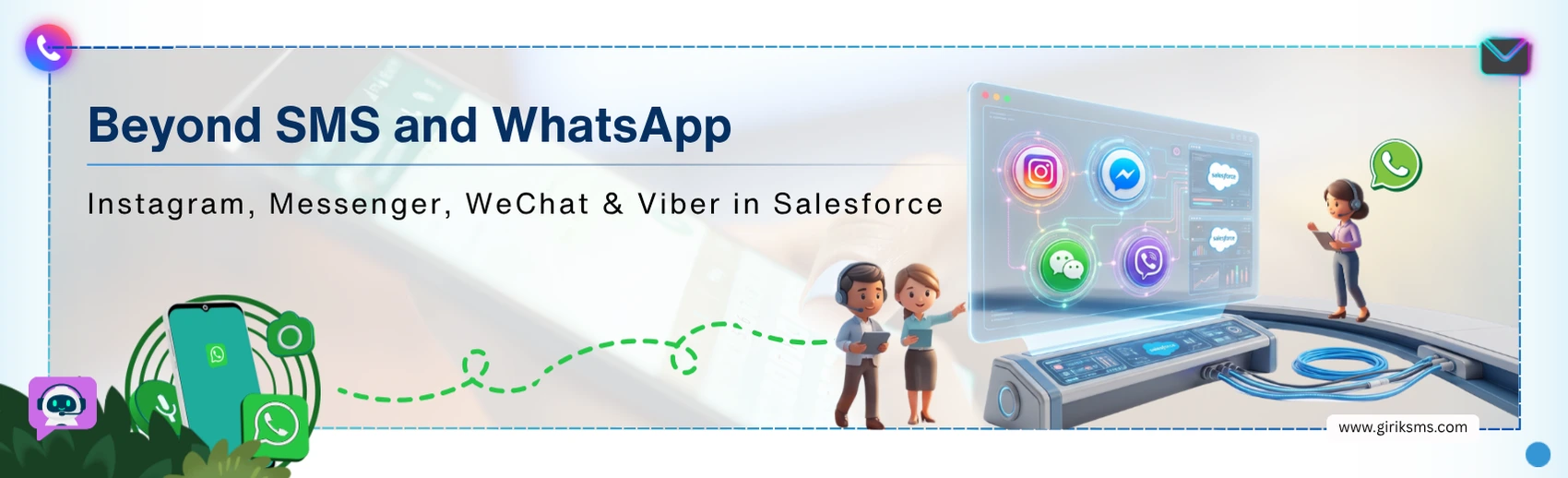
Let’s take a look at a scenario of a potential customer who found a business on Facebook and inquire about the product. Another customer sent a support message on Instagram, and a lead who has already purchased from you and used WhatsApp to get updates. At the same time, an international customer contacts your team on WeChat or Viber.
As customers continue to communicate on the channels they use every day; it becomes important for businesses to interact with them there. However, managing conversations across different messaging platforms is equal to working on various dashboards and applications. This is where Salesforce Instagram Facebook Messenger integration comes handy. Via this integration, organizations possess complete data about their customers and have the ability to automate workflows.
But why do companies go beyond SMS and WhatsApp and how the integration of WeChat, Messenger, Viber, and Instagram can enhance customer engagement. We’ll explore throughout the guide.
Why do Companies Switch from Traditional SMS and WhatsApp Communication?
Even if SMS and WhatsApp work brilliantly, they are still not enough in terms of customers’ journey, as other platforms like:
- Instagram appears to be one of the biggest customer service and sales platforms for fashion, beauty, retail, and ecommerce companies.
- Facebook Messenger is popular for all kinds of business communication and questions from clients.
- Viber continues to be favored in the Middle East, Eastern Europe, and some Asia-Pacific countries.
- WeChat becomes the go-to client communication platform for those businesses that operate in China and other parts of Asia.
Customers use various messaging channels according to their region and preferences. In such a way, limiting customer service to SMS and WhatsApp might make businesses lose some opportunities like:
- Reaching customers on their preferred messaging platforms
- Responding to inquiries more quickly
- Expanding into global and region-specific markets
- Centralizing conversation for better agent productivity
- Capturing and nurturing leads from social messaging apps
The Problem with Managing Multiple Messaging Platforms
When offering support on multiple communication channels improves customer accessibility, it also introduces operational complexities when these channels operate independently. Without a centralized workspace, agents are forced to:
- Log into each messaging app separately.
- Switch between browser tabs to respond to incoming queries.
- Search for previous information across different systems.
- Manually add conversation details and customer information to Salesforce.
- Ask customers to repeat information because conversion history isn’t centralized.
As a result, this fragmented workflow can lead to:
- Slower service delivery and longer resolution cycles.
- Duplicate customer records due to manual data entry.
- Decreased agents’ productivity as teams spend less time on interaction with customers and more time on switching between platforms.
- Missed or lost conversations when messages are spread to multiple platforms.
- Limited visibility into the complete communication journey, making it difficult to deliver consistent and personalized support.
Why Integrate Social Messaging with Salesforce
Salesforce becomes the one and only source of customer information, including purchases, customer service requests, contacts, sales opportunities, etc. This data is communicated to the agents so that they can:
- Automatically identify customers using existing CRM records.
- Mitigate the risk of data silos.
- Monitor conversion performance through centralized reporting and analytics.
How Salesforce Unifies Popular Messaging Platform
See how popular social messaging apps work within one CRM system helping sales and support units improve their communication.
Salesforce Instagram Integration
From being just a social media platform, Instagram has become a very important assisting channel for customer support and engagement. An increasing number of clients are turning to Instagram Direct Messages in search of information like pricing and asking about products. Nevertheless, with the rise in new customer expectations, a company finds it hard to manage interaction properly. But, no more with Salesforce Instagram integration that captures every message and associates it with the relevant customer record in the system. This ultimately allows organization to:
- Automatically convert Instagram inquiries into qualified Salesforce leads
- Assign conversations to the appropriate sales or support team using automation
- Monitor engagement and conversation performance through data-driven reports
- Link Instagram conversations to existing contacts, leads, or opportunities.
- Trigger automated follow-up workflows in an organization according to customer interactions
Salesforce Facebook Messenger for Smarter Communication
With Messenger being a popular contemporary channel that offers immediate and individualized service to businesses, it now engages with customers throughout the purchasing process and even after sales. Furthermore, agents get the advantage of having access to records like Customer profiles, Marketing preferences, Previous support tickets, Open opportunities without the need to switch between applications.
Common use cases include:
- Complaint management
- Product inquiries
- Customer support
- Lead qualification
- Appointment scheduling
- Order status updates
Connecting WeChat with Salesforce
The use of WeChat in combination with Salesforce helps companies reach out to their customers all around China and the rest of Asia-Pacific region through seamless integration and without having to deal with fragmented processes and platforms. This way, organizations can effectively handle any requests for assistance, questions about products and services or follow-ups on open cases, ensuring that they can:
- Speed up the process by managing conversations in a centralized environment.
- Gain complete visibility into customer interaction across regions.
- Offer high-quality services to customers independent of their location.
- Expand their operations globally by using an omnichannel approach to communications.
- Provide more personalized experiences with unified CRM data.
Viber Business Salesforce Integration
Having a significant user base in Eastern Europe, Southeast Asia, and some countries of the Middle East, Viber provides companies with the opportunity to connect with their customers in global markets. Every Viber interaction, no matter if it’s about a customer seeking product information, responding to promotional campaigns, and requesting assistance, is automatically linked to the appropriate Salesforce records. Thus, enabling agents to use complete customer context and deliver more informed responses. With the platform, organizations can:
- Expand customer communication beyond traditional messaging channels.
- Simplify cross-border customer engagement.
- Support scalable customer communication as the business grows globally.
- Ensure faster decision-making with centralized customer data.
- Increase team efficiency by reducing application switching.
Conclusion
As customer communication is changing, companies should come up with a single strategy that will ensure that all conversations are integrated. The incorporation of applications as Instagram, WhatsApp, SMS, Viber, Facebook Messenger, and WeChat through GirikSMS allows for an opportunity of improving communications and developing a personalized experience.
Therefore, regardless of whether one wants to improve customer support, automate replies, or connect to customers via the Internet, GirikSMS should be the right choice.