




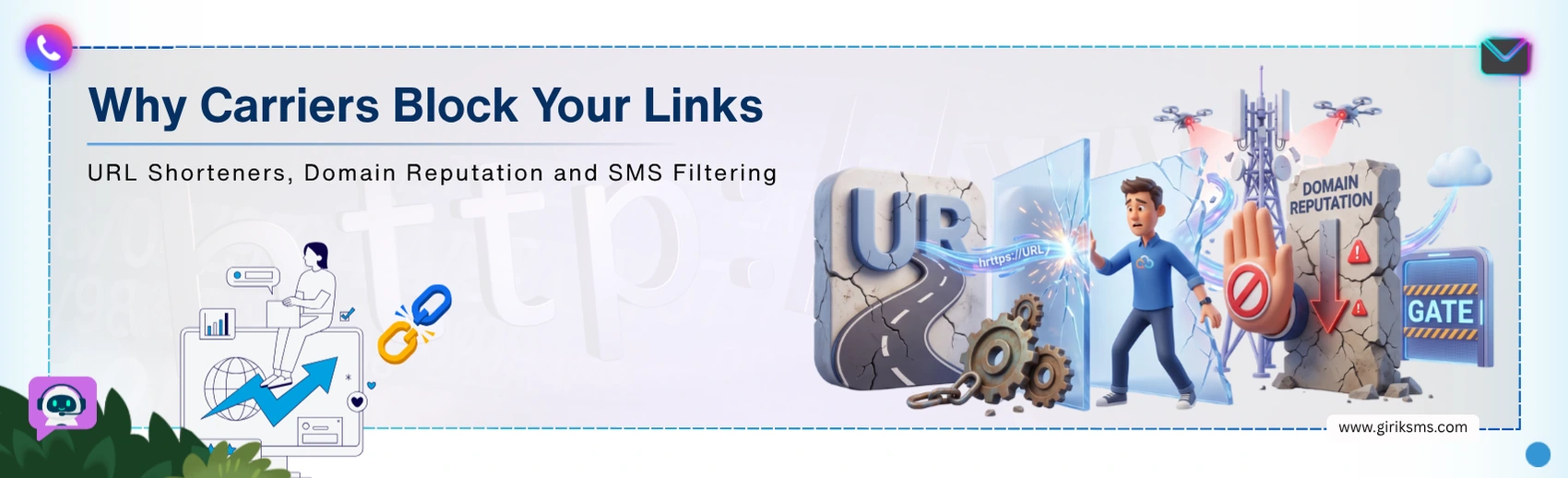
You may send an SMS, and the message may even leave your platform, but still not reach the recipient as you intended. The carrier often decides what ultimately reaches your audience. When the message includes a link, the carrier also has another element to evaluate before deciding whether that message should reach the subscriber.
A working URL does not automatically make a link safe from filtering. Carriers can look at the domain behind it, its reputation, redirect behavior, and the sending patterns associated with that URL. Shortened links add another layer because the visible URL may reveal little about its final destination. SMS link filtering is shaped by these signals, making the link itself part of the deliverability equation.
Why Do Carriers Block Links in SMS Messages?
Carriers process enormous volumes of messages, so automated filtering systems must make decisions at scale. They can assess the sender, message content, traffic patterns, destination URL, domain history, and recipient behavior.
The URL gets special focus since it might be used to conceal an unsafe destination. Shortening of the URL or redirection of an address only prevents the recipient and the automated system from knowing the final destination of the link.
That does not mean every link is suspicious. Instead, carriers evaluate the complete context. A recognizable sender using a consistent domain and predictable traffic pattern presents a different risk profile from a new sender suddenly distributing thousands of messages containing unfamiliar links. Understanding that distinction is important when diagnosing delivery issues.
The Problem with Generic URL Shorteners
Generic URL shorteners have one advantage: they make long addresses shorter, so they would fit perfectly into an SMS message. However, this means that the actual URL address no longer reveals the destination where the link may end up taking the receiver.
This causes suspicion because malicious senders have historically used redirects and short links to conceal phishing pages and other harmful destinations. Consequently, a business can encounter a shortened URL SMS blocked situation even when the final website is completely legitimate.
Shared shorteners can create another complication. Your business may share a shortening domain with many unrelated senders. In case that domain has a track record of suspicious activity or fraud, its reputation may become a problem for legitimate marketing campaigns. Domains with the business' brand name are typically associated with the business sending the message more easily. It also gives the organization greater control over the link infrastructure rather than making deliverability dependent on a shared domain.
Why Domain Reputation Affects Delivery
A domain is not evaluated solely on whether its website works today. Filtering systems can consider historical signals connected to the domain, including previous traffic, reported abuse, suspicious redirects, and other reputation indicators. This is why SMS URL reputation deserves attention when troubleshooting link delivery.
A sudden switch to a new domain can also change the signals associated with your messages. If delivery problems begin immediately after introducing a new link domain, that timing is worth investigating. Domain reputation should therefore be treated as part of your messaging infrastructure. The objective is not to manipulate filtering systems, but to maintain a consistent, transparent, trustworthy link destination.
How to Diagnose SMS Link Filtering
When a campaign performs poorly, avoid assuming that the URL is automatically responsible. Look for patterns across carriers, campaigns, senders, and domains. Start by asking four questions:
- Does the problem affect every carrier? If one carrier delivers normally while another filters messages, the issue may involve carrier-specific filtering or reputation signals rather than a broken destination.
- Did the problem start after a URL change? A sudden decline following the introduction of a new domain or redirect deserves investigation.
- Are messages without links delivering? If plain-text messages perform normally but messages containing URLs do not, the link infrastructure becomes a stronger suspect.
- Has sending volume changed? A sudden increase in traffic can alter the filtering context, particularly when combined with a new sender, domain, or campaign pattern.
These comparisons turn a vague delivery complaint into a more specific diagnosis.
What Protects Link Deliverability
Reducing link-related filtering starts with controlling the signals attached to the URL. Three areas deserve particular attention.
Use a domain you control. Organizations can have more control over their reputation when using a branded or dedicated link domain compared to a shared URL shortener. Moreover, a link becomes more identifiable with the sender if the same link domain is used for campaigns consistently.
Keep the redirect path simple. The URL in the SMS should lead through a predictable path to the intended destination. Unnecessary redirects, frequently changing destinations, or links that obscure where the recipient will land can create additional uncertainty for filtering systems. The fewer unexplained steps between the SMS and the final page, the easier the link is to evaluate.
Keep link behavior consistent with sending behavior. A new domain combined with a sudden increase in message volume creates a different filtering context from an established sender using the same domain at a stable volume. If a carrier blocks SMS links after a change in domain, traffic volume, or campaign pattern, compare those variables before changing the entire messaging setup.
These practices do not guarantee delivery. They reduce avoidable signals that can make legitimate links harder for carrier filtering systems to distinguish from risky traffic.
Conclusion
A functioning link is only one part of successful SMS delivery. Once a message enters carrier networks, the domain, redirect path, sending history, traffic patterns, and message context can all influence whether the message reaches the subscriber with its link intact. A working destination does not tell the whole story. SMS link filtering can take into account the domain behind the URL, its history, redirect behavior, and the sending patterns associated with it. Keeping these elements stable over time makes legitimate messaging traffic easier for carriers to distinguish from traffic that warrants additional scrutiny.