




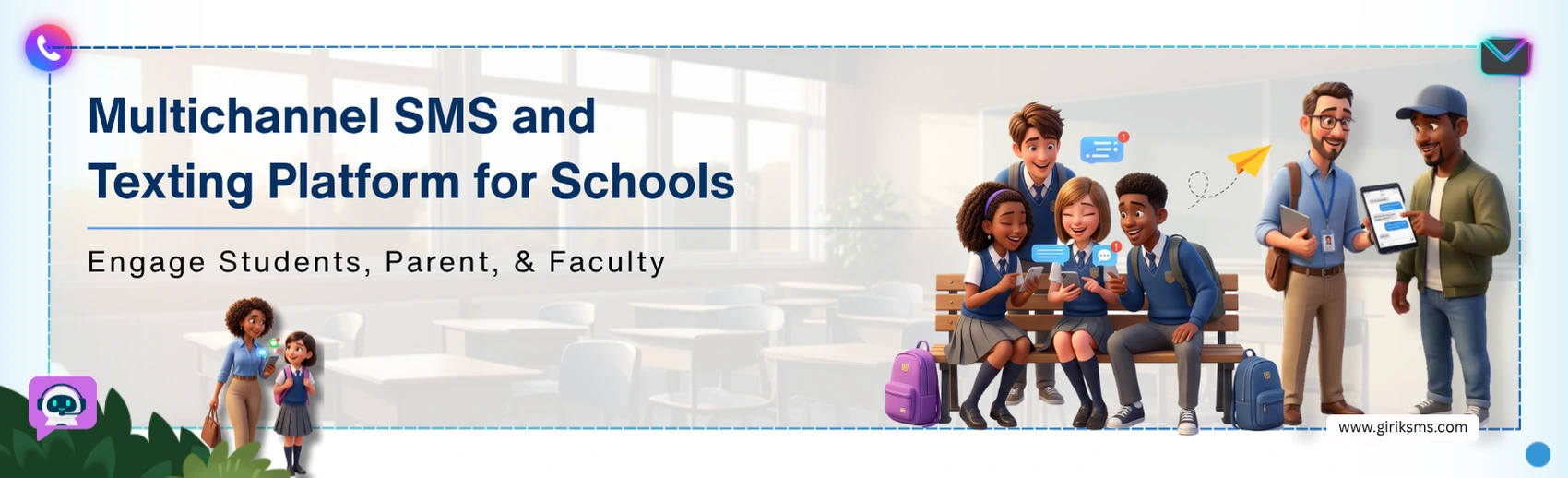
Every day, schools reach out to hundreds, if not thousands, of individuals who could be students, potential applicants, parents, teachers, and support staff to deliver various messages. These messages may include anything from an effort aimed at helping students fill out application forms, giving parents any information concerning their children, to letting people know about new classroom activities or administrative updates. Now, the challenge is not sending messages to keep people updated but making sure that they actually see it when it matters.
Important emails often remain unread. Calls are left unanswered, and thus critical information easily gets lost among competing priorities and busy schedules. With communication becoming increasingly distributed within teams and media, schools spend time following up rather than engaging. This is one reason many institutions adopt a text messaging service for schools. It makes the communication process easy to handle and even easier for the schools to reach out to parents and engage in better communication within the institution.
How Modern Schools Are Using SMS as Part of a Connected Communication Ecosystem
The reason emails and calls fall short is not always the channel itself. It is that they operate separately from the systems that generate the information schools need to communicate in the first place. In fact, communication practices in modern schools have changed a lot in recent years. Initially, SMS communication was used exclusively for notices, reminders, and emergencies. Though that is still true, there are other aspects of communication, including admissions, academic, administrative, finance, student services, and parent communication, being handled all at the same time.
Every day, schools generate information tied to applications, attendance records, fee payments, classroom activities, events, and student support. The difficulty is not creating that information. It is ensuring that it reaches the intended recipients without having to depend on any manual prompts or isolated systems.
This explains why a text messaging service for schools is most useful if it integrates well with other technologies that exist in the school setup. Instead of just being used as a messaging tool, SMS could be integrated with Student Information Systems (SIS), Enterprise Resource Planning (ERP) platforms, Customer Relationship Management (CRM), and admissions software to facilitate communication based on their activity.
An inquiry made by the prospective student will get the required information about how to proceed further with the application process. Attendance records can trigger notifications to parents. Payment reminders based on status and due dates can be generated and managed by fee management software. Communication is incorporated into the process rather than being something separate and manual for staff.
For schools managing larger relationship pipelines — admissions funnels, alumni networks, parent communication — that integration goes deeper. Salesforce adds another dimension to this process. Schools already use CRM systems for managing their relationships with prospects, applicants, parents, and alumni. By integrating SMS with Salesforce, the communications process is driven by the data that the team can use on a daily basis. Admissions teams can follow up faster, engagement activities become easier to track, and communication history stays connected to the people behind it.
The result is a communication model that feels more coordinated across departments. The exchange of information becomes more efficient; follow-up is easier and more students, parents, and faculties get updates that suit their requirements. Contemporary school SMS communication has moved beyond simply delivering announcements in mass form. It has become part of the operational systems schools already depend on, helping communication stay connected to the events, activities, and decisions happening across the institution.
How SMS Supports Every Stakeholder in the School Community
A major challenge for communicating within schools is that every audience is expecting different things and possibly at different times. A prospective student waiting to hear about their admission status, a parent trying to get information about their child’s attendance, and a faculty member arranging an event—all require some form of communication. A modern text messaging platform for schools helps bring those conversations together through a single communication framework.
SMS messages help schools to maintain contact with students throughout the entire process, from the moment they become an inquiry to graduation.
Admissions and Enrollment:
SMS services can be used to get inquiries made, communicate the status of applications, and share other important information regarding admissions to prospective students. It is equally useful in keeping students from getting disinterested in the process.
Deadlines and Academic Reminders:
Deadlines for assignments, examination timings, and registration timelines become easier to manage when there are direct reminders for the students.
Attendance and Student Assistance:
Problems related to attendance, counseling appointments, and assistance to the students can be conveyed before the problem starts affecting the grades of the learners. Such communication usually allows the learners to seek assistance where necessary.
Event Participation and Campus Engagement:
Workshops, orientation, extracurricular activities, and campus events frequently stand to gain from timely reminders, which boost participation.
Student Success Programs:
A lot of educational facilities make use of text messaging for schools as a tool to facilitate the processes of retention, engagement, and student success.
The involvement of parents in the learning process of their kids depends upon timely updates.
Absence and Late Arrival:
Timely alerts on attendance allow parents to be up-to-date with the current status of their kid’s education process.
Payment and Administrative Alerts:
Reminders on deadlines for payments, registration procedures, and account information can be sent using the school SMS messages.
Emergency Notifications:
Notifications that concern school closures, transportation disruptions, weather forecasts, and safety notices frequently need communications that reach families instantly.
School Communications and Announcements:
The institution’s announcements or academic communications can be communicated using text messages.
Involvement of Parents:
Keeping the family in the loop about their child’s activities helps foster collaboration between schools and parents.
Communication issues may arise in the background too, with faculty and administrators coordinating everyday work activities.
Scheduling and Calendar Notification:
Meeting reminders, scheduling changes, and calendar notifications are easily disseminated among different departments.
Team Coordination:
Different teams have to coordinate with each other for the completion of one task. Through SMS communication, delays in the process are avoided.
Operational Communication:
Schools frequently use mass texting for schools to distribute updates affecting multiple teams, particularly during major events or time-sensitive situations.
Administrative Updates:
Policies, training courses, compliance policies, and internal announcements can be conveyed through this channel instead of using email only.
Emergency Staff Communication:
Unexpected situations — campus incidents, weather disruptions, facility issues, or operational changes — often require rapid coordination. SMS helps ensure important information reaches faculty and staff without delay, regardless of whether they are monitoring email at that moment.
SMS is more than a channel for notifications when supported by a connected communication platform. It ensures that schools sustain consistent communication with students, parents, faculty, and staff and ensures that relevant information remains linked to day-to-day operations within schools.
Taking School Communication Further with a Multichannel SMS Platform
It is not only about adopting SMS inside a school communications system; rather, it is about making sure that the outreach accommodates people with varying communication preferences. Communication trends are constantly changing, and depending only on one type of communication may not always work. The manner in which a prospective student reacts to a follow-up may vary from how a parent wishes to be informed by the school.
This is where schools begin moving beyond a standalone text messaging service for schools and adopting a more connected, multichannel approach. Rather than managing separate tools for every channel, modern texting platforms for schools bring SMS, WhatsApp, WebChat, and automated messaging into a single environment while remaining connected to systems such as Salesforce.
The value is not simply having more channels available. It is having the flexibility to use the most effective channel for each situation. Admissions departments is able to follow up with prospective students in the ways they would react best; notifications can be sent out to parents through a means that they prefer. Faculty and administrative teams can coordinate more efficiently without switching between multiple applications throughout the day.
The admissions team, academic department, administrative staff, financial department, and student services communicate with the same people on different grounds. As schools expand, a centralized approach must be prioritized. When all departments use their messaging tool separately, visibility can suffer, and follow-ups become difficult to manage. Having a single system allows everyone to operate within the same history of interactions, resulting in better consistency.
Such platforms make it easier to centralize communication for schools without having to handle a scattered setup of systems. For instance, GirikSMS is a native Salesforce text messaging app for schools that provides one channel to manage SMS, WhatsApp, and WebChat interactions while connecting every conversation to the right student, parent, or staff account.
When it comes to one-to-one communication, student recruitment, or even mass text messaging for schools, a unified messaging platform can be much more beneficial than separate platforms doing the same thing. At this point, an SMS service for schools helps with broader engagement with effective results.
What Schools Can Expect When Communication Works as a Connected System
Implementing a text messaging service for schools is not only an innovation in communication; it is also a step toward achieving consistency and efficiency in keeping everyone informed.
Admissions Teams Convert More Inquiries
When follow-ups occur automatically via the same channel that the prospects respond through, there are fewer cold inquiries. This results in the admissions team spending less time trying to contact non-respondents and more time engaging in real dialogue with potential students who have shown genuine interest. The response rate becomes higher not due to additional efforts but due to the timeliness and relevance of communication.
Parents Stay Informed Without Schools Having to Follow Up Twice
When parents receive updates through a channel they notice, the back-and-forth reduces significantly. Attendance concerns get acknowledged faster. Fee deadlines are met more consistently. Emergency notifications reach families when it matters rather than hours later when an email is finally opened. Schools that previously spent significant time on follow-up calls find that most of those calls become unnecessary.
Administrative Teams Reclaim Time Spent on Routine Communication
A connected school text messaging system removes the manual effort behind routine outreach. Payment reminders go out without someone generating a list. Appointment confirmations send without a staff member making individual calls. Event reminders reach the right people without a coordinator manually tracking who received what. The time recovered is not insignificant — it accumulates across every department managing communication daily.
Faculty and Staff Coordinate Without the Email Dependency
Internal communication that previously relied entirely on email becomes faster and more reliable. Schedule changes reach the right people immediately. Urgent coordination during unexpected situations does not depend on whether someone is monitoring their inbox. Departments that regularly work across functions find it easier to stay aligned when updates arrive through a channel that does not compete with hundreds of other messages.
Engagement Becomes Measurable Rather Than Assumed
One of the less visible but significant shifts is that schools gain visibility into how communication is actually performing. Open rates, response patterns, and previous interaction, all are documented, removing the scope for guesswork in determining the right time for outreach, what method to use, and how to personalize communication for maximum impact. They are based on what the data from previous interactions actually shows.
Conclusion
Schools are not only communication centers. Schools are where students decide their future, parents put their trust, and the faculty turns up each day to facilitate both of these. When a communication breakdown occurs, it not only highlights an operational problem but also a real decision that has been made and a real individual who is affected by it. While a school text message communication system might not solve every problem, it eliminates the friction that creates such instances of poor communication. That matters beyond the metrics.