Outbound message compliance is commonly perceived as something that starts and ends with customer consent. Once the customer shares his/ her consent to a message, it is good to go. Simple!
But consent is only part of the picture. Compliance gaps still appear in teams that have done everything right on paper — opt-ins collected, opt-outs honored, templates approved. This gap usually arises from an unasked question: Who is sending that message?
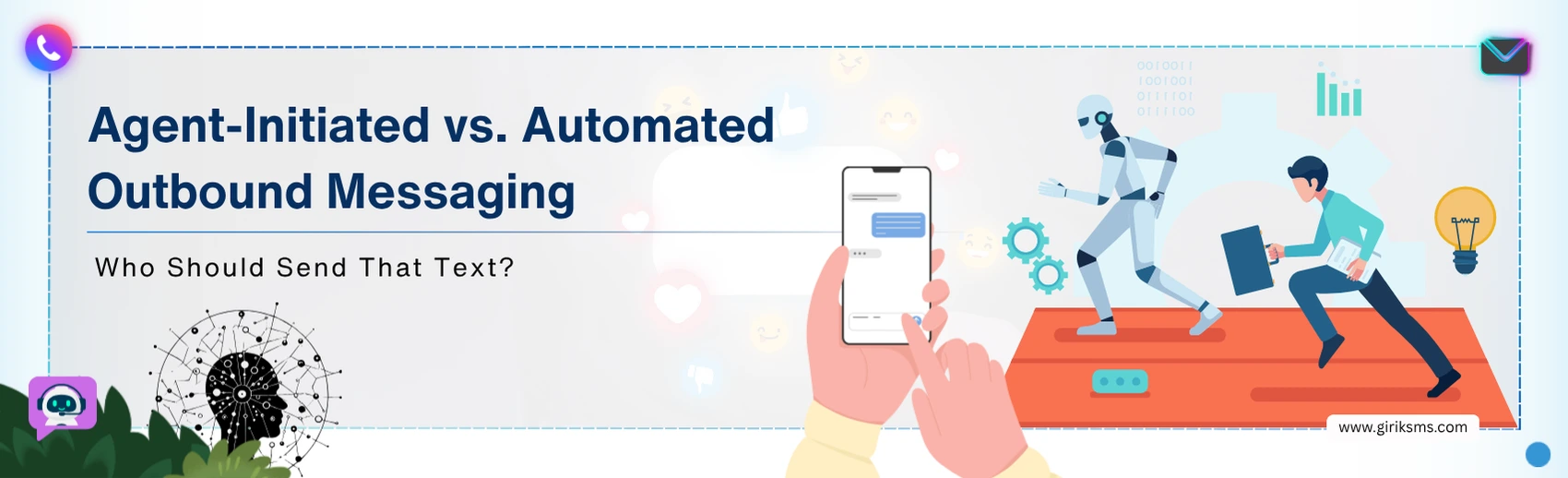
Every outbound text is created differently. Some messages are initiated directly by agents during customer interactions, while others are triggered automatically through workflows and business processes. While each method is used for a particular purpose, it also means different things for Salesforce outbound SMS compliance. It is important to understand these differences first before developing an outbound messaging strategy.
Understanding Agent-Initiated Outbound Messaging
Agent-initiated messaging is used in cases when contextual factors outweigh speed and volume. Sales representatives contacting customers after the conversation, service agents addressing issues that have not been solved yet, and account managers reaching out to customers before renewals are some common examples of agent initiated outbound messaging Salesforce teams deal with daily.
Human judgment makes all the difference. When a human agent reviews the messages and adjusts them based on the customer relationship, their preferences, and previous interactions before sending the messages, the outreach approach lands differently. This is especially relevant to relationship-oriented communications, complex service cases, and valuable customer contacts when a standard message may not be sufficient.
The trade-off is consistency. While automated processes adhere to pre-established rules, agent-based campaigns require the use of personal judgement. Different agents may approach similar situations differently, which is why clear governance and communication standards remain important from an outbound messaging compliance perspective. Agent-based communication is actually designed to be used in those cases where context, judgement, and adaptability are required.
What is Automated Outbound Messaging
Most customer conversations are unlikely to pose a challenge regarding whether the message should be delivered or not. A payment reminder is naturally expected before a due date, an appointment confirmation after a booking, or a service update is very likely to follow once a case status changes. These communications follow anticipated patterns, which make them perfect for automation.
Automated outbound messages help embed communications within business processes. Automation removes the dependence on people to remember all the follow-ups, since the messages are sent automatically when an event is triggered. This becomes crucial when customer volume increases and maintaining consistency is essential.
The real advantage of automation is how it eliminates loopholes that always arise due to manual efforts in the entire communication process. Customers get their notifications scheduled; workflows continue, and teams get to do much more than just focus on routine outreach. However, with automation, the quality of communication depends on how processes are defined and consents are managed.
This is why Salesforce outbound SMS compliance often becomes closely tied to workflow governance rather than individual agent behavior. That is why automated outbound communication is best regarded as a means of operation rather than a substitute for human exchange in conversations across the customer lifecycle.
A 4-Pillars Test for Choosing the Right Outbound Messaging Approach
Choosing an outbound messaging strategy depends on what fits rather than personal preference. The following four pillars will assist in making this choice.
01
Economic Value vs. Labor Cost
High-Value / Low-Volume Transactions: Agent-Initiated
When the business value of an interaction is high — renewals, strategic follow-ups, or complex resolutions — the risk of a misaligned automated message outweighs the efficiency it offers. However, these interactions require an agent’s judgement as the risk associated with mistakes is high.
Low-Value / High-Volume Transactions: Automated
Notifications such as payment reminders and appointment confirmations are transactional and follow a consistent pattern that does not need personal discretion. They can be efficiently done through automation at a level unmatched by any agent.
02
The Symmetry of Conversation
Highly Unpredictable / Collaborative: Agent-Initiated
When a conversation can proceed in several possible ways, like concerns, objections, or context, a human agent is needed, since the action that follows solely depends on the customer's reaction.
Highly Predictable / Binary: Automated
When the range of possible responses is limited, a confirmation, an opt-out, or no reply, automation handles the interaction reliably. The outcome is largely known before the conversation begins.
03
Execution Urgency and Timing
Real-Time / Event-Driven Communication: Automated
Messages tied to system events often lose value when delayed. Security alerts, service notifications, transaction updates, and status changes generally require immediate execution, making automation the more reliable choice.
Scheduled / Relationship-Driven: Agent-Initiated
When the right moment depends on knowing the customer and the relationship context, that judgment cannot come from a workflow condition. An agent understands when a message will land well; a system does not.
04
Data Readiness and System Triggers
Clean, Structured System Events: Automated
When the data is correct and linked with triggers that are dependable, confirmed opt-in, completion of the transaction process, and updating of the CRM system, the automation will occur correctly, making the Salesforce outbound SMS compliance trackable.
Qualitative / Context-Dependent Judgment: Agent-Initiated
When relevant information exists in the agent's understanding rather than a structured data field, automation has nothing reliable to act on. Acting on incomplete data is one of the most common sources of outbound messaging compliance risk and one of the most easily avoidable, keeping human judgment in the loop.
Conclusion
Most teams do not prefer to rely completely on a single model. Automation handles the predictable; agents handle the contextual. Both run in parallel, each applied where it fits. It is also the balance that makes Salesforce outbound SMS compliance manageable. Once teams are sure about the exact interactions to automate and those that need manual intervention, compliance problems become rare, not due to increased auditing but due to the inherent nature of the decision-making process itself.