



Most SMS automation depends on predefined triggers, fixed templates, and keyword matching. These systems struggle when a customer replies with the input the script cannot anticipate. At that point, the automated two-way texting struggles because the framework was designed to send messages, not made for follow-up workflows. For effective communication, you need more than a stored reply. The conversation must be consistent across channels, retain context, and interpret intent. If not properly offered, it leads to delayed response, poor customer experience, and exposure to compliance. Autonomous SMS conversations address this limitation.
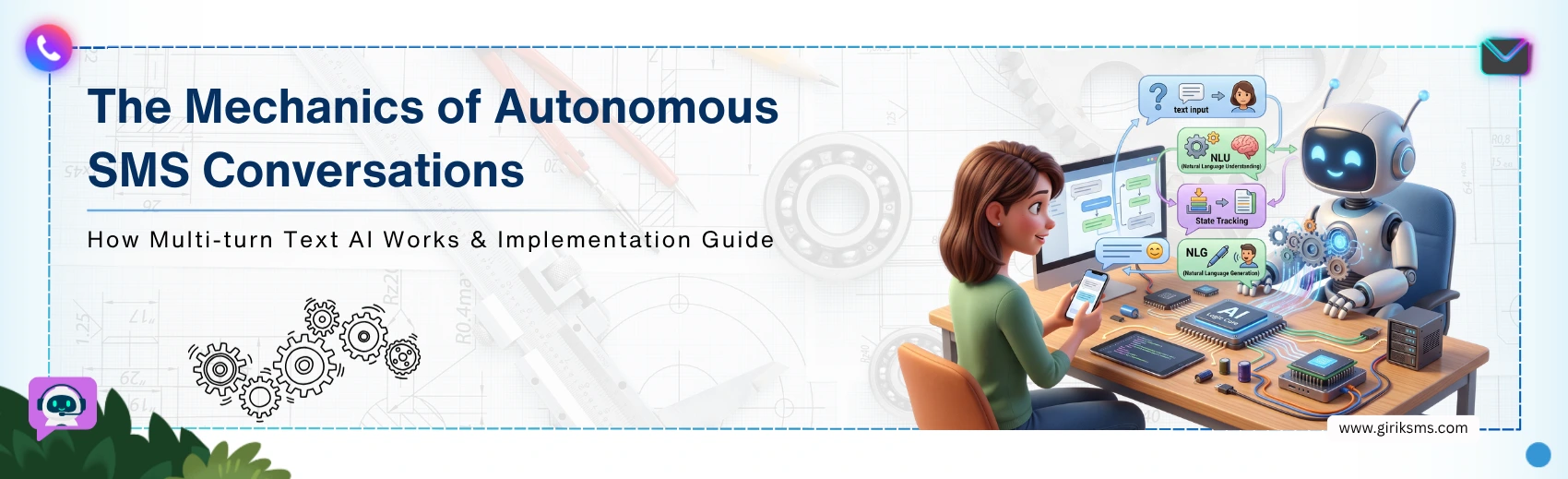
These AI agents process each incoming reply, retain relevant details from earlier exchanges, and decide the next step independently. So, let’s understand how multi‑turn text AI functions, where automated two‑way texting delivers value, and what enterprise teams should evaluate before adoption. In addition, we’ll also explore how automated two‑way texting moves enterprises from awareness to adoption that brings tangible differences.
Automated Texting vs Autonomous SMS Conversations
| Factors | Automated Texting | Autonomous SMS Conversations |
|---|---|---|
| Response Method | Reacts to fixed keywords | Works from meaning and intent |
| Message Handling | Templates treat each incoming message in isolation | Agents carry context forward across the full thread |
| Reply Options | Preset systems provide a narrow menu of canned replies | Agents generate responses suited to the actual question |
| Conversation Depth | Workflows often stall after one or two exchanges | Agents sustain dialogue across multiple turns |
| Decision Logic | Follows a single path regardless of input | Weighs several possible next steps and selects the most appropriate |
| Escalation | Triggered only when a specific keyword appears | Initiated based on the actual state of the exchange |
5 Ways AI Handles Multi-Turn Text Conversations
Intent recognition
Rather than matching a fixed phrase list, the agent works out what a customer is actually asking for. Variations in wording don’t disrupt the automated two-way texting process; it continues to generate a reply that aligns with the intent of the request.
Context retention
Information provided in previous parts of the thread remains visible throughout the interaction. The customer won’t have to reiterate information that is already told; the agent remembers and adds those details into the next responses, keeping them consistent and accurate.
Dynamic response generation
Responses get built for the specific question at hand, pulling from approved data and policy constraints, instead of coming from a small set of stock replies. Similar questions can produce noticeably different answers depending on context.
Action-oriented decisions
Autonomous SMS conversations aren’t confined to replies. It can schedule tasks, update records, or route requests to the correct team. Each decision reflects the requirements of the exchange, ensuring operational alignment.
Escalation awareness
When an issue falls outside the agent’s scope or confidence level, it identifies the limitation and transfers the conversation. Escalation occurs before an inadequate reply is sent, ensuring the concern is addressed appropriately in automated two-way texting.
Is Multi-Turn Text AI Different from a Chatbot or SMS Workflow?
Yes. Chatbot follows rule-based automation ‘if-then logic’ and struggles when a conversation goes beyond what it was scripted for. Basic chatbots handle limited back-and-forth through decision trees but carry little memory forward. An AI agent built for autonomous SMS conversations interprets what's being asked, retains context across turns, and applies judgment much closer to how a trained person would.
7 Steps to Implement Autonomous SMS Conversations in Salesforce
Map existing workflows
Go through current SMS processes and note where automation already handles things well, and where conversations tend to stall or get pushed to a human. This becomes the baseline for judging whether the agent actually helps once it's running.
Define approved knowledge sources
Give the agent access to verified data only: CRM records, documentation, policy references. Skipping this step in multi-turn text AI is usually what causes an agent to produce answers that sound reasonable but aren't accurate.
Set permission and escalation rules
Ensure that you’ve clarified the agent knows their limitations and what authority they hold to manage on their own and where human supervision is needed. These boundaries should be formally recorded and discussed, rather than depending on unchecked default settings.
Integrate with core systems
Link the agent directly to the CRM or messaging platform in use. This connection allows it to access records, update fields, and log history as conversations progress. Without integration, the agent operates on incomplete information, limiting accuracy and reliability.
Test and refine incrementally
Start with a small number of conversations, check results thoroughly, and expand only once escalation handling and accuracy are consistent. Phased rollout contains issues early, making resolution less costly than fixing problems after full launch.
Train staff and align processes
Prepare customer‑facing teams to work alongside the agent. Define how escalations are handled, how updates are logged, and how human agents step in without disrupting the customer experience.
Implement monitoring & reporting
Use dashboards and audit trails for reporting accuracy, compliance, and customer satisfaction. Feed the data from such systems into the data inputs to change workflows and to verify the agent is operating as needed.
When should an AI Agent Hand a Conversation to a Human?
Few situations where human judgment is needed no matter how capable the agent is:
- Complaints with financial or legal implications
- Requests that fall outside approved knowledge or policy
- Frustration that repeats across multiple turns
- High-value transactions that need manual verification
Where Autonomous SMS Conversations Deliver the Most Value
Scenarios when you need to manage high message volume with moderate complexity, like:
- Appointment scheduling or rescheduling it
- Order status and delivery updates
- Routine account or billing questions
- Lead qualification before a sales rep step in
Conclusion
Moving from scripted automation to autonomous SMS conversations brings a huge change to how customers experience support. Scripted replies give uniform responses, while agent‑driven exchanges address the actual request. For enterprises considering this transition with automated two-way texting, what’s important is they focus on establishing guardrails: knowledge sources, permission levels, and escalation paths. This ensures accuracy and reliability once agents manage real conversations. With those controls in place, autonomous SMS reduces manual workload and sustains coherent exchanges across the full conversation cycle.