



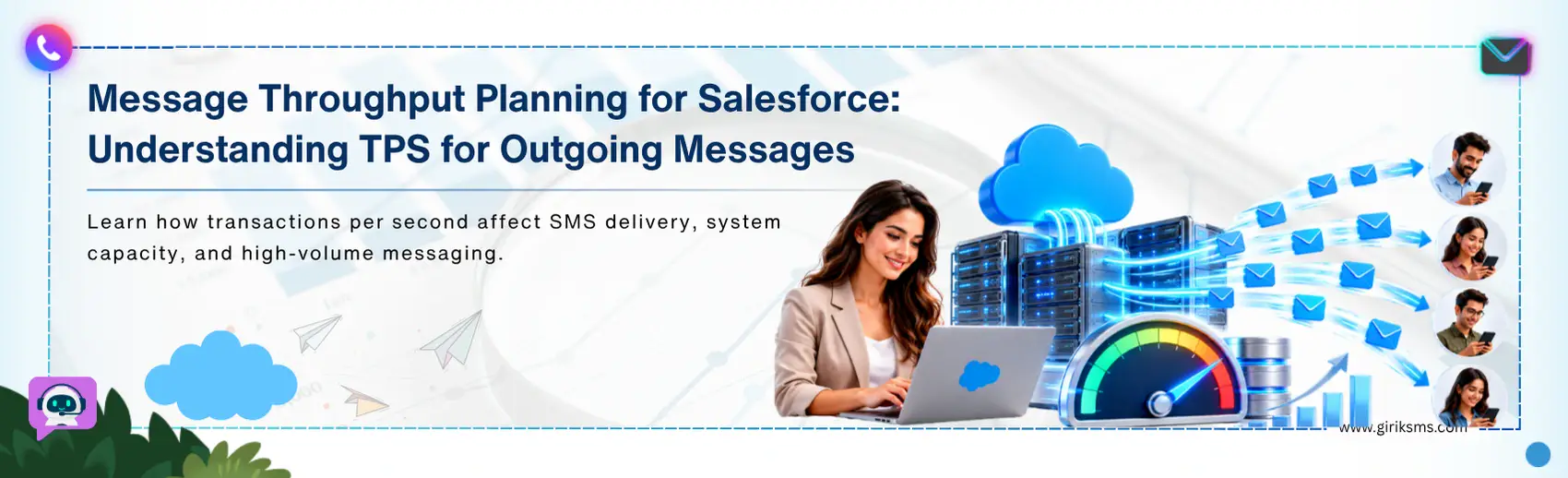
The time required to send the text message to 1,000 recipients will be different from that required for sending it to 100,000 recipients. At a lower volume, the speed of sending your text messages is not as critical. However, as your audience grows, it’s essential for businesses to recognize just how rapidly their SMS platform can send out messages. This is the point at which SMS throughput TPS becomes important.
Consider a scenario where your messaging system can send out 10 text messages every second; this means that in order to send 10,000 texts you can expect to wait for quite some time, especially during a rush hour when the messages build up and paired with the heavy influx of authentication requests. That’s why TPS is important for businesses that operate with Salesforce and send out alerts, notifications, advertising, and message campaigns.
What is SMS Throughput?
Throughput of an SMS channel means the rate at which messages can be delivered by the SMS channel in a particular time period. Another term for it, in addition to TPS (transactions per second) is MPS (messages per second).
For instance:
1 MPS = 60 messages per minute
10 MPS = 600 messages per minute
50 MPS = 3000 messages per minute
Why Does TPS Matter for Salesforce SMS?
Salesforce can initiate workflows, maintain information about clients, and identify contacts that can receive a text. Nevertheless, proper delivery of SMS depends on the provider and the mobile network involved. This aspect becomes vital for companies sending messages to a huge audience.
Consider a company sending:
- Customer service alerts
- Time-sensitive alerts
- Payment notifications
- Even announcements
- Order and shipping updates
If thousands of messages enter the sending queue at once, throughput determines how quickly the messaging system can process that queue.
How to Calculate SMS Campaign Send Time
A simple way to estimate the theoretical processing time:
Sending Time for the Campaign = Total Number of Messages / Rate of Delivering Messages
Let’s say that the text messaging campaign being run by the Salesforce involves 20,000 texts, and the speed of the sending process is 50 text messages per second. The duration required to send all the text messages would be calculated as:
20,000/50 = 400 seconds, 6 minutes and 40 seconds
While such computations are useful for campaign send time planning, they don’t guarantee delivery time.
TPS vs. Actual SMS Delivery Time: From Message Submission to Delivery
TPS refers to the count of messages that can be sent and processed by the SMS platform in one second, and SMS delivery is the period of time taken by the SMS platform to send the message to the recipient.
For example, if the TPS of the SMS platform reaches 100 and there are 10,000 messages to be sent in the campaign, then it will take 100 seconds to send these messages. However, the message must go through the delivery process after being sent. This involves;
- Salesforce
- SMS Platform
- Carrier Network
- Recipient’s Phone
Some messages may also be filtered, queued, delayed, or retried because of network conditions, carrier filtering, traffic volumes, destination, etc. This is why TPS should not be treated as a guaranteed delivery time.
What Can Affect SMS Throughput in Salesforce?
While evaluating SMS throughput Salesforce, businesses should look beyond a single TPS number.
Carrier Restrictions
Carriers may impose their own filtering rules and throughput limits. As a result, the maximum throughput supported by the messaging platform may not always equal the throughput available for every destination.
Message Destination
International campaigns can introduce additional variables. For example, a message sent to one country may follow different carrier rules for a message sent to another country. That’s why it is essential to evaluate throughput by destination rather than assuming one rate applies everywhere.
Sender Type
Depending on whether a business uses a toll-free number, long code, short code, or another approved sender configuration, different sender types can have different throughput limits, delivery capabilities, and messaging requirements.
Campaign Size
A small campaign may never reach a platform’s throughput limit. But if a business sends tens or hundreds or thousands of messages, even a relatively small difference in messages per second SMS can significantly affect the total processing window.
How to Plan a High-Volume Salesforce SMS Campaign?
The planning of a high-volume SMS campaign is initially about the relationship between the number of messages being sent out and the capacity to handle such numbers.
Start with the Audience Size
How many SMS messages the campaign will actually generate is the first step that you must consider. For instance, in case the campaign launched on Salesforce includes 75,000 recipients and 1 SMS per each contact:
75,000 contacts x 1 SMS = 75,000 messages
Understanding the total message volume gives you a starting point for calculating how much sending capacity the campaign requires.
Check the Available Throughput
Once you know the number of messages, calculate the number of messages per second your SMS can accommodate. Let’s assume a company is able to send up to 50 messages per second with 75,000 messages in its database. This will allow the company to calculate how much time it will need to send all messages.
75000 / 50 = 1500 seconds
This is approximately 25 minutes
Plan Around the Campaign Deadline
Now, let us compare the processed time with the required time when the customers will have to be reached. As such, in order for an organization that aims to reach out to 1000 clients before 6 PM, considering the processing time of 20 minutes, it should commence the whole procedure at 5:40 PM.
Final Note
Knowing your Transactions Per Second makes it easier to estimate campaign processing time and plan sends effectively. However, TPS does not guarantee when customers will receive the message. With GirikSMS, businesses can manage Salesforce campaigns more efficiently. They can send, schedule, and monitor texts through Salesforce. This makes it possible to plan message volume better and execute mass communication with customers without hassle.