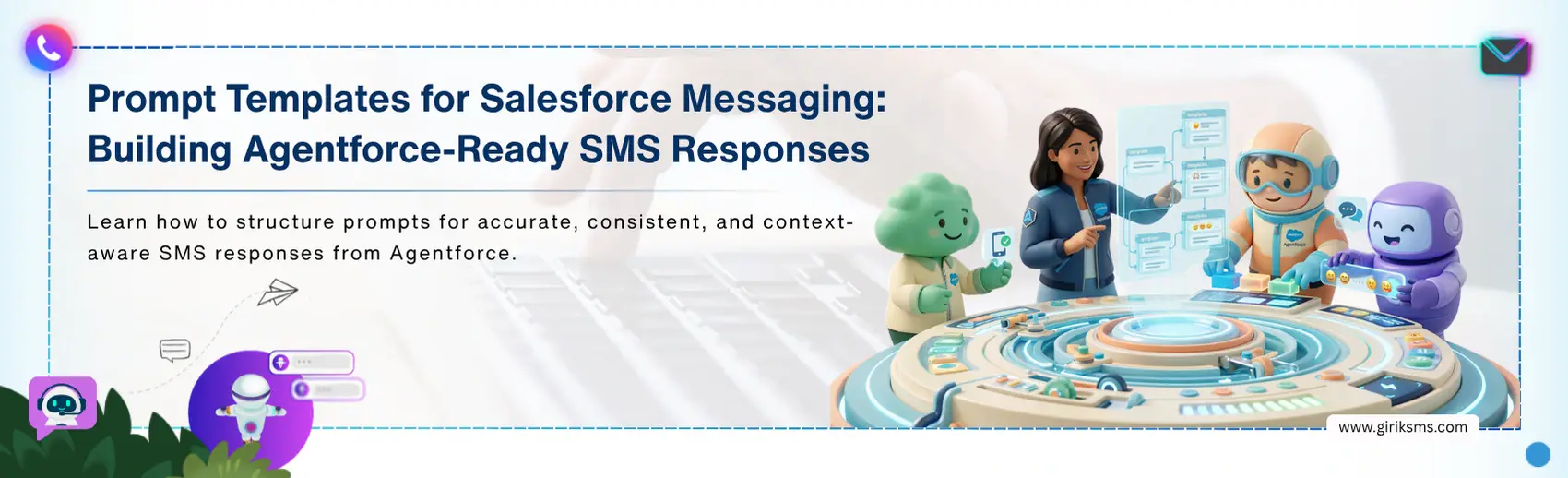
A customer who receives an irrelevant or incomplete SMS does not see an AI limitation. They see a service failure. For Salesforce teams, scaling automated messaging without consistent response logic can create fragmented customer experiences, inaccurate information, and unnecessary human escalations. Businesses need quick templates, and that aren't dependent on asking an agent to improvise every response. Salesforce prompt templates SMS workflows is a smarter solution that gives AI repeatable instructions for generating customer-facing messages from Salesforce data.
Driven by Salesforce Prompt Builder messaging, your team defines what the AI should use, say, avoid, and escalate with CRM context. Agentforce can then use these instructions within supported customer interactions. Let’s discuss some Agentforce prompt template text to help you standardize high-volume messaging while keeping responses connected to customer records and business rules.
What are Salesforce Prompt Templates for SMS?
Salesforce SMS prompt templates are reusable for AI instructions that determine how customer messages should be generated from the Salesforce context. A template can define the customer's record, case information, order status, approved knowledge, response objective, tone, length, and escalation rules. This creates a controlled framework for automated messaging instead of relying on open-ended AI generation. The objective is not simply faster message generation. It should be consistent with customer communication at scale.
For enterprise teams, the distinction matters:
- Manual messaging: Agents interpret records, draft responses, verify information, and send messages individually.
- Template-driven messaging: Defined instructions guide AI responses using approved Salesforce context and business rules.
Why Use Prompt Builder for Agentforce SMS Responses
Prompt Builder lets Salesforce teams create and test reusable prompt templates that can incorporate CRM information and supported resources. These can include record fields, flows, Apex, and related Salesforce data, depending on the configured template and use case.
That makes prompt builder messaging useful when a response needs more context than a generic AI instruction can provide.
For example, an order-status response can reference the actual order record rather than asking an AI model to infer delivery information. A case-update response can use the current case status and next action. A renewal message can reference the customer's subscription data.
The resulting workflow is more controlled:
- Salesforce data
- Prompt Builder instructions
- Agentforce response
- Customer SMS
Each layer has a defined role. Salesforce provides business context. Prompt Builder defines response behavior. Agentforce handles conversational interaction.
20 Salesforce SMS Prompt Templates for Your Team
The following templates cover common service, sales, and transactional scenarios. Replace bracketed fields with the relevant Salesforce resources.
Order Status
Confirm (Order Status) and (Expected Delivery) in under 320 characters. Do not invent delivery information.
Delivery Delay
Explain (Shipment Status) and (Updated ETA) briefly and provide the confirmed next step.
Appointment Reminder
Notify (Contact Name) about (Appointment Date/Time). Include (Location or Link) and keep the message concise.
Appointment Confirmation
Confirm (Appointment Details). Ask the customer to reply using the approved confirmation process.
Payment Reminder
Send a short reminder using (Invoice Status) and (Due Date). Include only verified billing information.
Payment Confirmation
Confirm (Payment Amount) for (Invoice Number) on (Payment Date). Use only verified billing details.
Case Acknowledgment
Confirm (Case Subject), provide (Case Number), and explain the next approved step.
Case Update
Summarize (Case Status) and (Next Action) in two short sentences. Escalate when (Escalation Condition) applies.
Account Verification
Ask the customer to complete (Approved Verification Method). Do not request sensitive information by SMS.
Renewal Reminder
State that (Subscription) is scheduled to be renewed on (Renewal Date). Include the approved renewal action.
Cancellation Request
Acknowledge the cancellation request and provide the next approved step from (Cancellation Policy). Escalate exceptions.
Feedback Request
After (Completed Interaction), request customer feedback using (Survey Link). Keep the message concise.
Product Availability
Using (Inventory Status), tell the customer whether (Product) is available. Do not infer stock levels.
Pricing Inquiry
Provide the current (Product Price) from Salesforce. Include (Approved Offer) only when present in the record.
Product Recommendation
Use (Customer Segment) and (Product Usage) to suggest products that meet [Eligibility Criteria]. Exclude unsupported claims.
Human Handoff
Tell the customer that (Issue) requires specialist assistance. Provide (Case Number) and the approved response timeframe.
Password Assistance
Provide approved password-reset instructions from (Knowledge Resource). Never request or repeat credentials.
Lead Follow-Up
Using (Lead Status) and (Last Interaction), ask one relevant qualification question and provide the approved next step.
After-Hours Response
Acknowledge (Customer Request). Provide (Business Hours) and state when the next reply will be sent.
Service Outage
Share outage details with (Service Status) and (Estimated Restoration). Do not speculate about restoration.
What Should an Agentforce SMS Prompt Template Contain?
A strong Agentforce prompt template text should define five elements:
- Role: Identify the service, sales, or support function.
- Context: Specify which Salesforce information the AI may use.
- Objective: Define the outcome required from the message.
- Constraints: Set character limits, tone, formatting, and prohibited claims.
- Escalation: Specify when the interaction requires human intervention.
This structure makes AI response templates Salesforce teams can govern, test, reuse, and adapt across customer journeys.
5 Tips to Build Salesforce Prompt Templates SMS
01
Tip 01
Define Role and Objective
Start by clarifying the service or sales function and the customer outcome. A strong Agentforce prompt template text begins with a clear purpose before adding context.
02
Tip 02
Map CRM Context
Reference verified Salesforce fields such as order status or case details. This ensures AI response templates Salesforce deliver accurate, data-anchored SMS messages instead of generic replies.
03
Tip 03
Set Rules and Limits
Define tone, character count, and compliance boundaries. Agentforce prompt template text should remain concise and customer-friendly, while ai response templates Salesforce must align with enterprise communication standards for SMS.
04
Tip 04
Add Escalation Logic
Include conditions for human handoff. Templates should specify when automation stops, such as sensitive requests or unresolved cases, ensuring seamless transition to agents.
05
Tip 05
Test Before Activation
Run templates against complete, incomplete, outdated, and conflicting records. This lets you verify reliability and prevent errors once the SMS workflow goes live.
Conclusion
Agentforce can automate customer conversations, but the quality of those conversations depends on the instructions and context behind them. Salesforce prompt templates SMS workflows, built with Prompt Builder, provide that structure as Agentforce applies those instructions during conversations. Together, these provide a practical foundation for scaling SMS automation without treating every customer's message as an open-ended AI generation task. Identify your highest-volume SMS workflows in Salesforce and build AI messaging on Salesforce that captures demand and converts conversations.