



The Salesforce Winter ’27 release is usually announced on October 12, 2026, and includes capabilities around agent interoperability, voice experiences, multilingual interactions, Agentforce observability, and augmented agent management. Agentforce is being enabled by default across editions that are eligible, and existing orgs have been getting rolling enablement since the opening week of September 2026.
Nobody’s Watching the Inbox showcases how queries of clients, leads, or urgent support emails remain unanswered either during off-hours or when employees are busy. With reference to Salesforce Winter '27 release, this issue of inbound SMS auto reply for unmatched inbound WhatsApp and SMS messages is tackled by expanding Agentforce and autonomous AI agents devised to manage interactions, qualify pipelines, and undertake service cases round-the-clock across several channels.
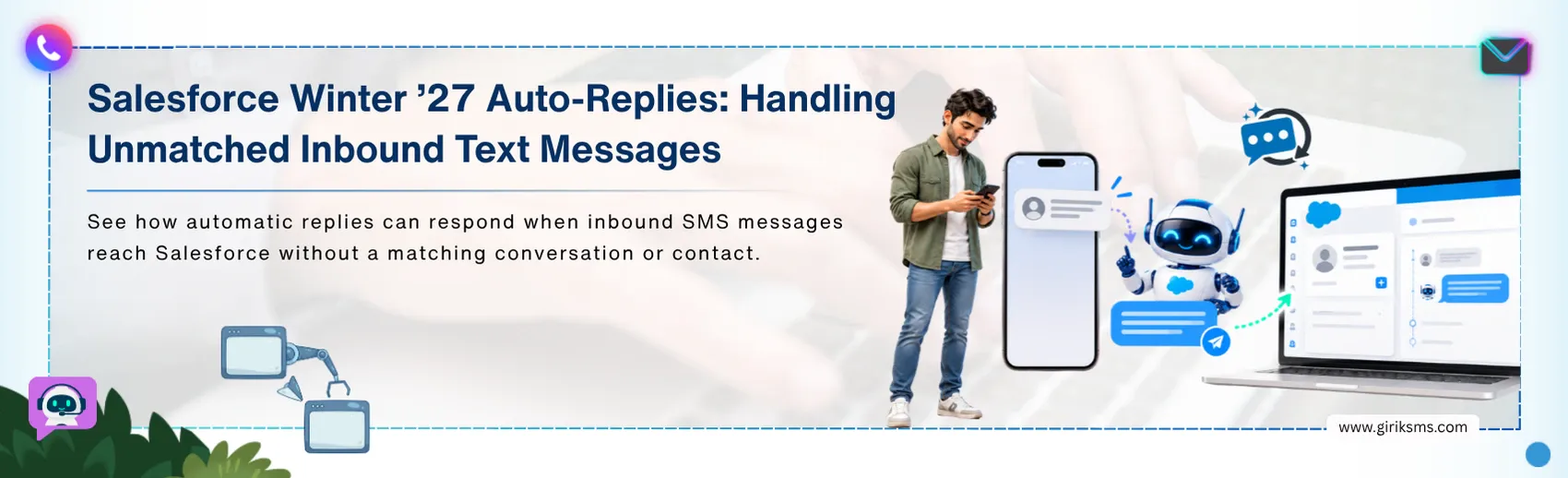
In fact, Salesforce’s Winter ’27 release explicitly lists “Answer Unmatched Inbound Message Salesforce with a Default Response” as a new capability. The idea is simple: when an incoming message fails to match an existing consent request, active flow keyword, or continuing discussion, Salesforce can offer a fallback rather than leaving the customer speculating what happened.
Why is a Fallback SMS Response Crucial?
As compared to emails, SMS creates an altogether different client expectation. Users sending text messages expect instant response in some or the other way. Even a short response can reaffirm the sender that their message was received.
An inbound SMS auto reply can achieve the following three things:
- Acknowledge the message
- Set expectancies
- Guide through the next step
For instance:
“Thanks for associating with XYZ Company. We have received your message, but this number isn't supervised for direct requests. For and assistance send ‘HELP’ or browse through our support page.”
The message doesn't pretend that an agent is instantly available. Rather, it provides the customer a clear way ahead.
How Winter ’27 Solves the “Nobody’s Watching” Problem?
Salesforce’s Winter ’27 release brings a feature for managing unmatched inbound SMS and WhatsApp messages. This will empower businesses to set up a default response for messages that don’t relate to existing interaction.
For SMS Unified Messaging, Salesforce documentation explains that this feature controls what happens when an incoming message does not match:
- An approval request
- An active flow keyword
- A continuing conversation
Administrators now have the option to choose how Salesforce must handle these unique messages. The available options comprise sending the Marketing Cloud Next default response, leveraging agent conversational settings, using Marketing Cloud Engagement settings, or just overlooking the message.
That provides businesses with a crucial operational choice. Rather than treating every message that doesn’t match with an ongoing conversation as an error, organizations can determine whether the applicable response is automation, routing, or silence.
How the Salesforce Default Reply Works?
The default reply SMS Salesforce administrators configure acts as a net that filters unmatched incoming messages.
The breakdown of the process is as follows:
- User sends an SMS
- Salesforce checks consent, as well as keywords
- checks flows
- checks active discussions
- no match
- sends the default reply
For example, a customer sends ‘STOP’, rather than sending a basic message such as, “Thanks for contacting us.” Salesforce should manage the opt-out request.
Likewise, if a customer is going through a flow, Salesforce must continue with that discussion rather than sending a standard fallback message.
As per Salesforce, keywords that are related to compliance, messages staying for a flow response, and active flow keywords take priority over the default response.
This approach makes the unmatched messages process more dependable while helping businesses avoid sending unrelated or unclear automated replies.
What Should Your Automated SMS Response Say?
Automated SMS response should be short, clear, effective, and honest. It should convey to the customer that their message was delivered. It should detail what their next plan of action is.
Salesforce recommends keeping responses short i.e. staying within the character limits of the messaging channel. A valuable default response includes three simple elements:
1. Confirm the Message
Let the customers know that their message was received.
Example:
“Thanks for connecting with us.”
2. Justify the Situation
If no one is free to act in response, briefly explain why.
“This number isn't investigated for direct client requests.”
3. Provide a Next Step
Tell them how they can find more information.
“Please reply HELP for assistance or visit our service center.”
A complete default reply SMS when put together could say:
“Thanks for reaching out to our Company. This number isn't supervised for direct requests. Please write HELP or visit our support center for support.”
The right message will be determined by how the number is utilized. A marketing number may require different wording from the one used for sales, client support, appointment reminders, or transactional messages.
Setting Up the Default Response in Salesforce
For Unified SMS Messaging, the documentation of current setup of Salesforce directs administrators to:
- Setup
- SMS Codes
- select the SMS code
- Resolve Remaining Inbound Messages
The administrator can select Use Default Response (Marketing Cloud Next) and enter the response text.
Before configuring it, Salesforce states that the SMS code should already be equipped and compliance and flow keywords that should take precedence should be arranged. This is a crucial implementation sequence.
Don't begin with the fallback message. Start with the customer journey and ask the following:
- Which messages need consent handling?
- Which keywords trigger flows?
- Which responses should reach a bot?
- Which interaction must reach an agent?
- Which messages can receive a standard response?
- Which messages should be overlooked?
Only then will the fallback become the final layer.
Why Does Compliance Still Take Precedence?
Automation doesn't do away with the requirement to follow SMS compliance requirements. Consent is handled through subscriptions. Organizations must ensure fallback messages never escape opt-out requests or consent controls. They must also follow right sender-registration conditions, telecom requirements, quiet hours, message-specific rules and more.
Final Words:
To ensure customers get acknowledgement response, monitoring the inbox round-the-clock isn’t required. Winter ’27 gives Salesforce administrators strong control over messages that remain unmatched with recent interactions. A well-outlined inbound SMS auto reply should do much more than acknowledging receipt of message. Besides respecting consent and describing next steps, it guides customers in the right way. The ‘default reply’ capability can become a valuable aspect of a broader messaging strategy.