



All you need is to have your phone number, connect it to your messaging service, and start sending test—Toll-free messaging is very easy on the outside.
The reality is less forgiving.
However, before carriers allow this traffic to move on their networks, they want to know the identity of the sender, the type of the report, the consented party, and the message content. What started as filling out a few details has now become a lengthy waiting game, where one must provide web URLs, samples of messages and descriptions of campaigns.
This article focuses on this unnerving fact. Let’s get into what toll-free verification SMS actually requires, how long it can take, and why applications that look perfectly reasonable on the surface still get rejected.
What is Toll-Free Verification SMS?
While referring to the carrier review process for business messaging sent from toll-free numbers; Verification helps establish that your traffic is tied to a real business and a legitimate messaging use case. While eliminating unwanted messages, it ensures that the right traffic reaches customers at scale.
When you submit a verification application, you are essentially giving carriers a snapshot of your messaging program:
- Who is the business?
- What does it sell or provide?
- How do those recipients' opt-in?
- What does the actual message look like?
- How frequently will they receive them?
- What types of messages will they receive?
- Where do links in those messages lead?
All these aspects need to be considered. Also, ensure that your use case is aligned with your business description, sample messages, and anticipated traffic.
Why Toll-Free Verification Matters for Business Texting
Even if a company is using a toll-free number, it may still face some problems when traffic is not properly verified.
The number itself isn’t the whole story. The carrier cares about the behavior behind the number. Without it, even a perfectly legitimate campaign can find itself in a kind of delivery limbo where messages don’t perform the way the sender expects.
A bad actor may send 50,000 unsolicited promotions.
A legitimate company may send 50,000 appointment reminders.
However, volume alone is not enough. This means that when requiring a toll free number texting approval, businesses should pay attention to the consent, sender’s identity, traffic patterns of messages, content of messages, and the relationship between the business and recipients.
What Information is Essential for Toll-Free Verification?
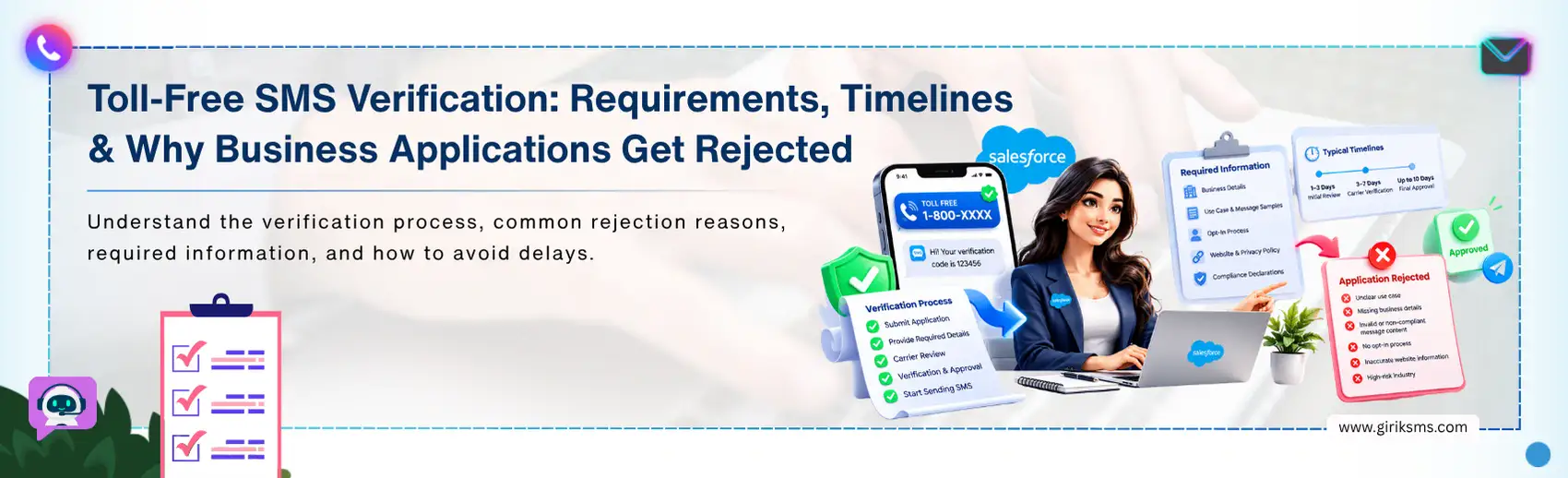
The exact TFN verification requirements can vary on the messaging provider and the way this number is being used. However, serious applications for verification usually boil down to a couple of major points.
Business Identity
Start with the basics, but don’t treat them casually.
You’ll typically need information such as:
- Legal or business name
- Business address
- Website
- Industry
- Business registration or tax information
- Business contact information
The important thing to consider is consistency.
If your business' legal name is different from what you put in your messaging profile and website, it will create confusion in the review process of your application. A reviewer should not play detective while evaluating your company’s information.
Messaging Use Case
This is where vague descriptions start causing trouble.
Businesses write descriptions like
“We use SMS to communicate with customers.”
Technically true
Practically useless
The carrier needs more context.
Compare it to: “We send reminders, confirmations of appointments, and notifications of rescheduling to our customers who approach us via the website.”
Now, the reviewer already knows the cause, audience, and the goal of the notifications.
Thus, instead of putting forward pretty marketing terms, just say in plain words what you are selling, who the receivers are, and how they have opted in to receive the notification.
Message Flow
Any application needs to provide a summary of what happened before, after, and during the message delivery.
Steps of SMS opt-in are as follows:
- Visiting site
- signing up for SMS service
- scheduling appointment
- receiving confirmation message about appointment
- getting a reminder about the appointment
The sequence is more powerful than just saying “we send transactional messages.”
Opting in
The mere fact that the customer gave his/her phone number at check-out doesn’t necessarily mean the customer consented to any communication.
If you want to contact your clients to send them reminders about appointments, it is essential to inform the clients how they have consented to receive this communication from you. If the messages contain any marketing materials, you should need to inform the clients how they have consented to such messages from you.
Opt-in Proof
One should present proof that the consent was received via the specified method.
- Website URLs
- Keyword-based opt-in instructions
- Screenshots of the opt-in form
- Checkout or registration screens
- SMS disclosure language
- Other evidence showing how consent is collected
The closer the evidence matches the explanation in your application, the cleaner the review tends to be.
Sample Messages
Instead of submitting random text samples that anybody can use, one should send real messages that will show reviewers the way the traffic will look like and for what reason people will be receiving those messages.
For example,
"Hello (Name), we have something really interesting to tell you!"
It tells the reviewer almost nothing.
A better example would be,
“Hello (Name), your meeting with (Name of the company) is for October 15 at 5 PM.”
The difference isn’t cosmetic.
The first one presents the basic function of the messaging program while the second one states a fact.
How Long is the Process for Toll-Free verification?
Depending on the service provider, the messaging use case, the quality of the application submitted, and whether further information is needed, this process may take varying lengths of time.
While a good application will easily get verified without any hassles, a confusing application will become a game of "back and forth" between you and the service provider.
And once a launch date is decided upon for a campaign, each day spent in waiting is costly. That’s the harsh truth because the reviewer does not care that the marketing team already designated the campaign, and the CEO already announced the launch date.
It implies that sending the verification application on Friday afternoon won’t be a useful approach if you expect to dispatch large numbers of SMSs next Monday.
Why Are Toll-Free Applications Get Rejected?
Rejection is not often accompanied by that surprising turn of events that people think about. More often, it’s a collection of small problems.
The Use Case is Too Vague
Using a simple phrase of “marketing messages sent to customers” does not conclude anything. You need to fill in:
- What kind of marketing?
- To whom?
- How did they opt in?
- What products or services are promoted?
- How frequent are messages sent?
If the reviewer has to provide information regarding these, your application has already created unnecessary uncertainty.
The Opt-In Process Isn’t Clear
If there is no obvious SMS consent mechanism on the website or the customer has to hunt for the opt-in disclosure, the reviewer probably isn’t going to give the process the benefit of the doubt.
Sample Messages Don’t Match the Use Case
The whole application should be one coherent story. So, if you describe transactional notifications but submit promotional samples, this will not work.
Messaging Volume is not Explained
The organization stating that it occasionally sends notifications to its customers but plans its traffic in volumes typically associated with big marketing drives will get an extra level of attention. Since volume, in itself, does not pose any problem, unexplained volume does.
The Messages Look like Spam
The existence of suspicious links, unknown sender details, false information, or hard-sell tactics can make genuine traffic appear to be less genuine. This is where toll free SMS rejected becomes the result that businesses wanted to avoid.
Conclusion
Businesses that depend on toll free SMS verification can be assured that a combination of proper consent to receive messages, actual message content, an appropriate template message, and a good reason for sending it will result in no unnecessary delays or refusals.
This makes traffic, consent process, and content line up, bringing far less for a reviewer to question. And that is ultimately what makes a verification application easier to approve, and your business texting more reliable.